Saturday, May 26, 2012

A Sampler of Hope


A Sampler of Hope

     In the bustle of a busy week the telephone rang. It was a reminder that someone loved by the Lady-of-the-House was scheduled for “further tests” the next day. Medical exams can be unnerving. By accompanying the patient she would lend support. She would also have a portion of time with nothing to do. She made preparations for it. She supplied her denim bag. A row of strawberries was all that was left to stitch on her “carnation” sampler. Slow and steady is how she stitches. There really is no other way to do it. Little stitches can’t be rushed. Recently, however, time reserved for stitching had vanished into thin air.


     With the linen rolled in a towel, her thread tucked into the pockets of the sewing case, with her smallest pair of scissors, oh yes, and the plastic magnifying lens she wears around her neck to see the stitches, she was set.

     During the test she waited in the car. It was a beautiful cool spring morning. She clung to hopeful thoughts for the patient although the results of the test would come later. Her natural temperament veers toward melancholy. She must be mindful of seeing roses beyond thorns, honey beyond bee stings.

     Of St Paul’s three; faith, hope and love, love is emboldened by feeling. Faith relies on the intellect. Hope involves the will. Hope optimistically reaches out a hand in the dark to turn on the light. It sees the good and the beautiful in the light of the Kingdom of God.

Hope is like the sun, which as we journey toward it, casts the shadow of our burden behind us. Samuel Smiles  

     Through car windows the Lady-of-the-House glanced around the plaza. Everything was emerald green. Neatly trimmed bushes and flowering trees bordered the parking lot and walkways. Someone evidently had hired the right landscaper. A fountain was attracting twittering birds but the sound of tweets and splashing water was faint. Here’s why. A young man was mowing and edging the grass. At one end of the parking lot food service trucks backed up to an historic stone house, converted into a fine restaurant. Around the corner of the medical building, out of her line of vision, was the main air conditioning unit roaring low but unendingly. The Lady-of-the-House sighed. “Sometimes this is almost a perfect world,” she thought and twisted to the backseat for her denim bag.


     She unrolled the linen, threaded the needle and made the first pink stitch. It was some minutes before her shoulders begin to soften. She prayed for the patient and remembered to make a calming prayer of appreciation for peace in the midst a nervous, distracting world. Her shoulders softened some more. “I never get tired of stitching strawberries,” she mused soothingly. Vines, however, are another matter. Without accurate counting the picking out of wayward stitches follows.

     On the way home the Man-of-the-House and the Lady-of-the-House stopped at some of the many roadside stands in their neighborhood and filled two baskets.


     Stitching strawberries and eating strawberries made the Lady-of-the-House wonder how many strawberries are on the walls of her house. She has never counted all the strawberries on all her samplers but the number must be high. 


     And for years there has hung a plump beaded velvet strawberry, with satin flower, on the drawer of her desk – made by a friend. Lovely.


     On Saturday the Lady-of-the-House roasted asparagus in the oven. 


     She made her usual avocado sandwich on homemade bread but added strawberries as a lark. Different, but delicious. 


     Then she sat on the patio to stitch her last strawberry. The relaxing moment was worth waiting for.


The Man-of-the-House


     The Man-of-the-House was sitting across from her. He likes to unwind with an mp3 plugged into his ears. He was listening to old radio recordings of the comedians Bob & Ray. 

     “It’s done,” his wife announced.

     “Very nice,” he smiled. She read him the verse. “Very nice,” he said again. He was concise but sincere. 


     While bouncing back and forth in indecision on how to personalize her sampler, she added birds and rabbits from other charts, and eventually settled upon a verse by Emily Dickinson. It is a ponderous reminder. 


     She squeezed in the last two words in a manner done on many a girlhood sampler in days of old.
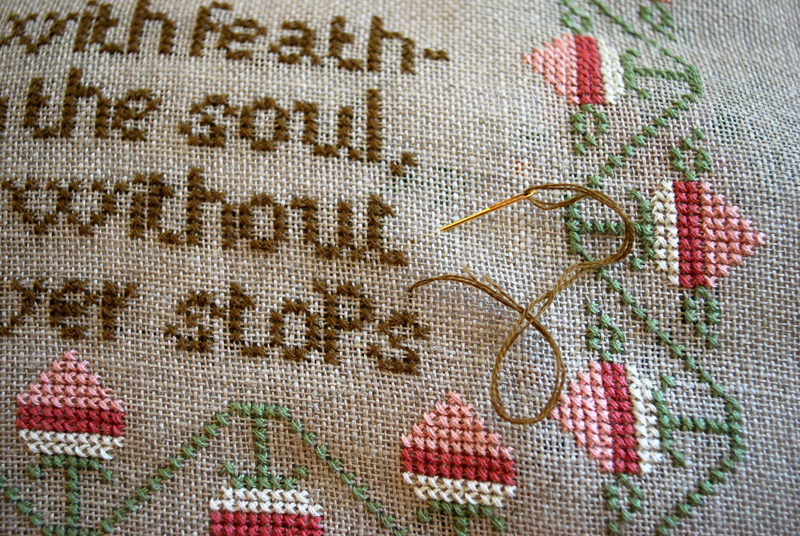


     The verse replaces Mary Rule’s name and other identifying notes she originally stitched in 1848. But the piece will be remembered as a sort of partnership, past and present, of feminine work and whimsy by the Lady-of-the-House.


     During the week a friendly letter came her way. The young mother had an optimist’s cheerful tone of gratitude in her pen. She spoke of the joy of home teaching and seeing the world through the eyes of her little children – no doubt with newness, a sense of wonder, and with purity. The Lady-of-the-House affirmed this joy in her reply and added, “They’re seeing the world through your eyes, too.” 


    Post Script

Awaiting framing

     For “hope” in education see “Parents as Inspirers” posted October 2, 2010.

     The chart is by “Lady in Thread.”
   

Roasted Asparagus 
     For my friends who asked how to roast asparagus when I told them what I'd been up to. With a vegetable peeler remove skin from midway along spears. Place in a roasting pan. With the peeler handy, shave two or three carrots into a pile of strips. Cut a sweet onion into wedges. Add carrot and onion to asparagus. Drizzle a tablespoon of olive oil over vegetables to lightly coat. Sprinkle with salt. Bake at 350 for 20-25 minutes or until fork tender. 


     Remove from oven and season with fresh herbs of choice. Serve as a side dish (as shown) or chopped and tossed with pasta and grated Romano cheese. Try fennel bulb sliced thinly in place of onion. 

     Thank you for visiting,
     Karen Andreola 

Tuesday, May 15, 2012

Short Lessons


Short Lessons

Sisters' House at Ephrata Cloister constructed 1743


     This article is decorated with spring flowers spotted at the Ephrata Cloister and our house. I hope they are worth the extra minutes it may take to come up on your computer. April showers bring May flowers. This year, however, it’s been strangely the reverse. Our May flowers bloomed early, in the sunshine of April. The rain has waited until May.


“Whatever the natural gifts of the child it is only in so far as the habit of attention is cultivated in him that is he is able to make use of them.” *1 Charlotte Mason


     In Miss Charlotte Mason’s book, Home Education originally published in 1886 she explains how to develop the power of attention in children. All children regardless of what century they were born, need to be trained to fixing their attention to the task at hand. But because children in the 1880s were not surrounded by screens and had no portable gadgets at their fingertips, their attention was not lulled or lured as it is today. Therefore my first recommendation for those interested in what I call the “Gentle Art of Learning” is to keep media to a bare minimum.

Conrad Beissel's Study at Ephrata Cloister. House contructed late 1740's

Bright & Pleasant
     To discourage dawdling Miss Mason urges the home teacher to aim to keep each lesson “bright and pleasant.” Short lessons help secure full attention. The child learns to bring to his work his full mind to bear, whether it is arithmetic, penmanship, phonics, listening to a history story, or drawing something from the nature table. If a lesson goes stale and he does dawdle his teacher moves him onto the next lesson in the timetable - a lesson that as unlike the last as possible. Then he is brought back with “freshened wits to his unfinished task.” 

Pink azalea at the edge of our woods

Promptness
     When a young student understands that definite work is to be finished in a given time it will help train him in habits of diligence. If ample leisure is to be enjoyed later in the day then there is “no time like the present” to do our lessons. Most subjects for a child under age nine need not be any longer than twenty minutes. Some lessons will be less. The habit of fixing his attention is a valuable one. He will carry the strength of this habit all through his school years.  

“The teacher herself must be alert . . . The tortoise will lag behind the hare, but the tortoise must be trained to move, every day, a trifle quicker. Aim steadily at securing quickness of apprehension and execution and that goes far towards getting it.” *2


Nigel Andreola, age 3 on his grandparent's porch in 1992


Zeal 
Yellow tulips at Ephrata Cloister
     Parents want their children to have the “best” curriculum. This is admirable. But the same parents can also be haunted by fears that their children will have “holes.” Consequently the biggest courses are chosen. I call them Cadillac courses. With a Cadillac course it isn’t unusual for a second grader to be spending more than an hour on math problems, for instance. Those who design Cadillac courses apparently consider their subject to be top importance. When a whole collection of  “top important” subjects fill the day a teacher can’t help but feel weighed down. Subjects drag on. 
     Very soon, September’s sparkling enthusiasm is replaced with a sense of weariness. A teacher who misunderstands how a child’s power of attention develops, that it strengthens over years, may become agitated and impatient. It is then that she sees no other choice but to resort to an educational method that relies heavily on reward and punishment. What else can be done to get her student through his schoolwork? Mom is miserable. No one is having a good time.


“The child must not be allowed to get into the mood in which he says, Oh, I am so tired of sums, or of history.’ His zeal must be stimulated; there must always be a pleasing vista before him; and steady, untiring application to work should be held up as honorable, while fitful attention and effort are scouted.” *3

Purple phlox, Ephrata Cloister

Golden Minutes
     An alternative to the Cadillac course is to try something new, something flexible, something accommodating to short lessons. If this is out of the question cut a big course down to size. In spite of the command in the teacher’s guide to “do every problem,” in spite of a conscientious inclination to do every correlating activity, trust in the power of short and bright lessons. Your child’s close attention to half the problems on a page, for example, during those first ten to twenty golden minutes, is time better spent than a wandering attention on a whole page of problems. Although a chapter of history, for instance, may be concise, if it is intriguing, presented with a careful rendering of detail, it will, indeed, invite a student to be thorough. And the carefully chosen words of an author who loves his subject will inspirer a narration. Knowledge is the goal over how many problems are completed on the page, how many pages are read in a chapter. 

Red azalea, Our house


Variety
     Here is another principle that discourages inattentiveness. It is one that Charlotte Mason says will help keep students “wits on the alert.” Place lessons in order.  There are advantages for the child’s developing mind when lessons are “judiciously alternated.” When we vary the kind of lessons one part of the brain is at rest renewing itself, while another part is engaged. For example, a new math concept is welcome while the mind is fresh. A lesson of observation may follow - such as a student looking closely at a new art print for art appreciation – describing it with eyes closed. After some memory work a thinking lesson might follow - such as reading and narration. Fifteen minutes of nature drawing may precede a painstaking lesson. 


Red lupine, Our house
Excellence
     Short lessons are a legitimate “short cut.” They invite concentrated effort. (The fact that they seem like short cuts at all could be because we are used to the normality of conventional school classroom periods.) Let each effort be toward excellence. Whether it is writing a sentence or paragraph in his copybook, a row of arithmetic problems, reading aloud a poem or literature, the child should accomplish these things with his best work. 
     Determine the right skill level first (irrespective of grade level) and do not allow the work to be “slip-shod.” (The horseshoe needs to fit snugly to the hoof.) Better six neat, unhurried, deliberate letter “Es” for penmanship than two rows of  “Es” that drift off to be messier down the page. Better several long division problems accomplished with fastidious attention to each step and a good attitude of  “I can do this” - than a student who greets a crowded page of problems with pessimism. An “I can’t ” in frustration, or even tears, might be coming from the repeated experience of making careless mistakes as a lesson drags on in tedium.  


Ephrata Cloister

A Full & Tidy Schedule
     Even older students (through eigth grade) will benefit from short lessons of sorts. Short lessons make possible a tidy schedule of interesting subjects beyond the 3Rs  – doable with a smile. For when it comes to paying attention, the interesting things to think about are the strongest attraction of all.

My pot of flowering thyme

A wide curriculum is Miss Mason’s concern when she says,

“For it is a mistake to suppose that the greater the number of ‘subjects’ the greater the scholar’s labour; the contrary is the case as the variety in itself affords refreshment. . . .
Not the number of subjects but the hours of work bring fatigue to the scholar; and bearing this in mind we have short lessons and no evening preparation [no homework].” *4


Hyacinth, Our house


     My dear readers, Christ tells us that the Father has gifted His children with differing talents. We grow in wisdom and love when we faithfully walk in what He has prepared for us. Little steps, for the faithful, have big consequences by and by. (Mathew 25:21) 

What is your experience? Discussion is invited.

End Notes
Charlotte Mason, Home Education, C.M.R.& S. Co., 1989, page 146
Ibid., page 149
3  Ibid., page 150
4  Charlotte Mason, Philosophy of Education, C.M.R.&S. Co., 1989, page 158

Zinnia at the kitchen door needing planting

Post Script
     Last week I worked on this article in response to a question I received from a young mother. This week I polished it. Thank you for your letters. They give me ideas to write about and a way to minister. I hope you have enjoyed seeing the flowers. This solitary twig of white bleeding hearts was a lovely surprise. It is already a favorite flower of mine but this gave me further joy. My German friend says they are called weeping hearts in her country. I like this name better. Aren't they the sweetest flower?

Weeping hearts, Our house

     I had another surprise. As I happened to be reading Still Glides the Stream by Flora Thompson I fell upon a Victorian painting in the book. This illustration is so peaceful and sweet – I planned to scan it for use in the article with the title “Ample Leisure” while I was in the midst of writing. At the end of the week I received a card from a friend who lives across the Atlantic Ocean. On her card is the same painting. Thus, this photograph instead.
     I have found (over my years) that coincidences aren’t rare among the like-minded. Therefore I shouldn’t really be surprised anymore. But I will always be delighted. For I know that someday it will happen again.

A like-minded coincidence

Another notable point. Did you know that the May chapter in Mrs. Sharp’s Traditions begins with an old country song from Flora Thompson’s childhood as preserved in her book, Lark Rise to Candleford? The reference is in the finest of print – too small for our camera to show you – although I did try.

Mrs. Sharp's Traditions open to "May"

A of review Flora Thompson’s book is in “Goodbye to Lark Rise posted September 2010. A mention of Mrs. Sharp’s Traditions is in “A Victorian Spark” posted October 2010.

My weeping hearts have gotten billowy, photographed just before we headed off to Ephrata Cloister

Thank you for visiting,
Karen Andreola

Tuesday, April 24, 2012

Red, Blue, Make-do and Mend (if you've a fancy to)


Red, Blue
Make-do and Mend
(if you’ve a fancy to)

     The Lady-of-the-House confesses to keeping at least two ankle-length jean skirts in her wardrobe. Fellow wearers of the jean skirt know how it stands up to the rigors of house cleaning, endures frequent washings, even on the hottest setting. One of her jean skirts is new. The other has had a long life.

     During the winter months she had only worn “the other” for stay-at-home. The Man-of-the-House decided she had worn it out. It cannot be said how long he kept his opinion to himself but his patience finally came to a halt. It startled the Lady-of-the-House. She was peacefully going about her business in the kitchen wearing a pretty pink apron, whiping breakfast crumbs from the counter, when he was frank with her. He said calmly but firmly, “I can’t stand seeing you in that skirt.”

     “Why?” she asked, with eyes wide and a voice as sweet as pie, as if she were hurt and had no idea he could be so mean, all the while knowing precisely what he was referring to.
    
     “It’s ripped and shredded, that’s why.” After the truth was out he reiterated, “I can’t stand seeing you in it.” This drove the point home. No husband wants to see his wife in rags.
 
     “I’ll mend it,” was his wife’s stubborn reply disguised as a bright idea. She didn’t wish to part with the one dependable everyday skirt that fit her perfectly. But she was half-confident she could mend it. Perhaps she was only forestalling the inevitable.

     “Hmm,” he answered unconvinced. He sighed deeply and stepped into his office to start his workday. It was unmistakably a sigh of exasperation. Without showing you the back of the skirt in this post it will suffice to say that it was so vertically ripped at the back and horizontally frayed at the hem that even when mended would never pass for a 1930’s dignified simplicity - a standard respectful of both civility and economy.


A New Skirt (Sort of)
    
     Mindful of her husband’s words (he was right) more drastic measures than mending were necessary to save her skirt and give it a new lease on life. She set about reconstruction. She dug into her tub of quilting cotton and found a half-yard of a blue that might do. “I can cut the hem high up – just above the nasty rip,” she ventured, “and with this cotton add a flounce for length.” This she did with happy success. While she was cutting and ironing the fabric she read its title: "Aged Elegance." As she fancied this description to be applicable to her project, it gave a lift to her work. 

     The moment of truth came when she put the skirt on. The Lady-of-the-House opened the door of her husband’s office and interrupted his concentration with a brief fashion show, twirling ‘round what little floor space the room has to offer, humming a tune for accompaniment. The Man-of-the-House took off his reading glasses and said, “Where’d you get that?” It wasn’t the response she had hoped for. Experience told her, however, that translated into the feminine it meant, “Oh, you’re wearing a new skirt. It’s nice.”

     “Do you like it?”
     “Yes, I do.” She thought she spied one eyebrow go up and was pleased. 
     “Oh goodie, because it’s the skirt you wanted me to throw away.” She couldn’t resist the jab. A smidgen of playful banter in marriage keeps communication open. He smiled and was duly and pleasantly impressed.

A New Purse (Sort of)
     That same week the adult son of the Lady-of-the-House told her, “Mom, don’t you think it’s time for a new purse.” She was surprised.
     “Do I detect a theme going around the house? I’ll have you know this is a Vera Bradley.”
     “A Vera what?”
     “Never mind.”
   
     She had grown fond of her posh purse – a gift from her mother almost a decade ago (who calls a purse a “pocket book” while others call it a handbag.) The purse had seen continual wear and certainly had been around. For this reason the Lady-of-the-House likes how washable these purses are. Yet hers was in a sorry state.  

     “This red goes with my red sandals – the only shoe-purse match I have in the house for the upcoming season,” she realized. She fretted alone with her thoughts, knowing her menfolk couldn’t possible sympathize to the degree she would find satisfactory. Although she hadn’t been known in the past for living up to the gentility of matching accessories, at least she might accomplish it now - with the red purse.


     “I’ll mend it,” she decided. Visiting the variety store in town, which sells cotton remnants, she settled on a calico to cover the threadbare handles. Patches will make-do for shopping. At the grocery store and the farm stand no one will notice the tampered-with handles that could mar Vera Bradley’s fine reputation – not in my little town,” she consoled herself. 


     When her married daughter stopped by, the Lady-of-the-House pointed to the red purse hanging on the corner cupboard. She asked her daughter what she thought of it. Her daughter's face looked puzzled. "Isn’t that the same purse you’ve always had?” 
     “No, it’s had surgery. I patched it up and gave it a new row of quilting.”
     “Really?” She gave it a second glance and said, “Oh, I see” with a giggle, “I didn’t notice.”  
     The Lady-of-the-House should have been happy with this but she had to admit that her home school graduate’s observation skills were a bit weak. On the other hand, to receive approval for the funny but neatly mended handles – from a female – was encouraging.  

A New Book Bag (Sort of)

     When a toddler the Lady-of-the-House (she has been told) had never clung to a security blanket. Looking at the good half-yard of denim that was cut off the bottom of her favorite jean skirt . . .  well  . . . she felt like Charles M. Schulz’s Linus. “How can I recycle this lovely soft, naturally aged fabric,” she wondered. “I know. I’ll make that book bag for myself that I’ve been meaning to make. I can use the remainder of the calico for the lining and add a bit of lace,” she daydreamed.


     It was only when she finished the project that she realized the reason for her mysterious attachment. It was nostalgia. The bag is made from the jean skirt that she wore during her final years of home teaching.

     This pile of snippets is all that is left of the red and blue make-do and mend. This, she can throw away.


Post Script
     I hope these stories bring a quiet spot of gaiety into your day.

     Going through google’s new “awaiting moderation” I find that I’ve somehow missed some of your kind comments on back posts. I’m sorry. I wonder how this could be. Both Dean, alias Man-of-the-House, and myself read them - he often before I do. I welcome his protection. I welcome your comments, too.

In Between Posts


     I’ve been writing articles for magazines. I was asked to be a columnist for “The Old Schoolhouse” on line magazine to write about Miss Charlotte Mason’s principles and am endeavoring to do so under the heading “Gentle Art of Learning.” We had the family of Paul and Gena Suarez (editors) in our home for a meal and found that we never ran out of things to talk about. I was also asked to be a guest writer for “HomeEducating Family.” Editor Kathleen Warren is a homeschool mom I met while living in Nashville twenty years ago. She was a subscriber to my “Parents’ Review” in the 1990s. 


Best Wishes,
(so says the ornate tea cup I purchased in the house of my great great grandmother Emma Cook which is now an antique shop painted pink.)

Karen Andreola