Showing posts with label Charlotte Mason Education. Show all posts

Sunday, March 11, 2018

Drawing Shyness by Karen Andreola


Drawing Shyness

My children all liked to draw - - - and were unhampered by drawing lessons because I didn't give them such lessons in their early years. Only in later years did they have a few drawing lessons, on shape and shading.
(One resource was an old kit by Jon Gnagy. It was eagerly taken up.)

Before that, I simply said, "Draw what you see." 

That was enough.


I let them draw here and draw there - with no criticism from me (unless I was pressed. Then I'd give "one" pointer.)

"You like our pictures because you're our mother," they would moan.

"Okay, okay, if you wanna get picky - - - that sunflower is disproportionately wide in the stem." Choice vocabulary would always appease them. With that, my job was done. "Now, let me bring this basket of clean laundry upstairs and get another started in the washer."

Drawing is a sort of slow-growth "learn-as-you-go." I found children are self-correcting. Doesn't this make a teacher sound lax or lazy?


Miss Mason humorously admits to being "shy in speaking" about drawing. This is because she didn't hamper her students with instruction, either. The less a teacher does "for" students, the more she is frowned upon by the school-ish establishment. 

She didn't care, however. She simply let children draw what blossomed in their imagination connected with the reading of the day.

She was impressed, too, with how the children used "all their paper" in drawing what they observed of the world around them. *1


She says,

"They give you horses leaping brooks, dogs running after cats, sheep on the road, always with a sense of motion. . . a gardener sharpening his scythe, their mother sewing, a man rowing, or driving, or mowing.

They have a delightful and courageous sense of color, and any child will convince you that he has it in him to be an artist.”

“ . . . Their field studies give them great scope. The first buttercup in a child's nature notebook is shockingly crude . . . but by and by another buttercup will appear with the delicate poise, uplift and radiance of the growing flower." *2

How delightfully sweet!

*1&*2 Charlotte Mason, Philosophy of Ed. p.217

Dear friend,
You are not a lax or lazy teacher if you give your students the assignment to draw - - - and then set them free - - - to draw what they see.


(I first made this a Facebook Post for Monday morning. Then, I thought I ought to place it on the blog here for those who prefer not to scroll there.)

Good News
Yolanda and Daniel are moving back to Lancaster County because he found a job here. Meanwhile Sophia and Andrew (and my grandchildren) are moving an hour away rather than three. We are all looking forward to seeing more of each other this year.

Yolanda is expecting a baby this summer. She has waited a long time. I'm praying she will keep the baby as the women in our family have a history of miscarriages. 

Spring is around the corner. Snowdrops are in bloom down the road. I hope, very soon, to be relieved of the symptoms of cabin fever. Weeding the garden has risen in my estimation to be a sought-after occupation. 


I am looking forward to digging in the garden - especially after watching the film "Secret Garden" with Margaret O'Brien last week. This melodramatic version (complete with temper tantrums) is actually pretty close to the book.

Until next time,
Karen Andreola 

Copyright Karen Andreola, 2018

Sunday, February 18, 2018

I am, I can, I ought, I will.

I am, I can, I ought, I will.

1989 - Tennessee. Sophia and Yolanda are still close today. 
The Motto
The motto of the P.N.E.U is for persons of any age and position.

In the middle of the school year it is good to be reminded of our motivations.


Family-Style 
One of the benefits of home learning is that children look up to adults.

In an age-integrated environment, spiritual and intellectual meals are served family-style with discussion and narration part of the menu plan.

Students work independently with lovely focus too, keeping a record of their learning in notebooks and through projects.

The smallest segment of their learning is experienced within a group of  peers in a co-op, perhaps, within meaningful activities, these can include opportunities for ministering to others.

In his pamphlet, A Generation Which Knew Not the Lord, addressing why an alarming number of children raised in Christian homes are leaving the church, pastor Joseph P. Cammilleri says,

"The godliest young people that I have observed are those who spent the most time with their families; family dependence, so to speak, in contrast to peer dependence."

Yolanda and I made tea cozies for gifts one year. We made some in blue pots, too.
With family-style learning, even grandparents may get into-the-act. This year a mother shared with me how her retired father studied WWII with her son (for high-school credit). History was a favorite subject of Grandpa's. He is gone now but during those influential years he was esteemed for his teaching-love. What Grandpa left behind him, in the heart and mind of his grandson, is special and immeasurable.

In the philosophy of secular humanism (and hedonism) there exists no higher authority than man (or self). Yikes. We see what a mess this philosophy makes of a civil society and the lives of individuals. Yet, this is the religion of the government schools and Universities. It is also the religion of Hollywood.

Being brought-up in a Christian household a student is blessed by living with higher and purer ideals than what is presented in the government schools. His ideals steam from the Word of God. Let's look at a few ideals today, within the motto.


The first draft of my book is finished. I am contemplating pictures for it.
Ideals
Ideals are way up high. We have to reach for them. Carl Shultz said,

"Ideals are like stars; you will not succeed in touching them with your hands. But like the seafaring man on the desert of waters, you [use] them as your guides, and following them you will reach your destiny."

It stretches our personality while it develops our character, to reach for an ideal - although what we actually achieve will be somewhere lower. I am reminded of a song I used to sing in Sunday school - "We Are Climbing Jacob's Ladder." We reach-up to climb. The song had hand motions to go with it. When I think of Charlotte Mason's motto I think of climbing Jacob's Ladder. The first step of the ladder is:

This is the cover of one of my Victorian books. Isn't she sweet?
I am. 

If I am a Christian who am I? I am an ordinary person and have sin-nature, but if my faith is in Christ I am a new creation.*1 Through His Holy Spirit I am a partaker of the divine nature.*2 I am a person redeemed,*3 ransomed,*4 reconciled,*5 adopted.*6 I am of the elect*7 and accepted in the beloved.*8 etc.

Many beautiful old hymns were written in praise of who we are in Christ. Please feel free to share any favorites in the comments.

I can.

I can reach for an ideal. A series of failures may result in setbacks because I am an ordinary person. But each effort should bring me a little nearer to the goal. Christ chose ordinary men to be his disciples. To these ordinary men were left the important work of continuing what Christ began.

"But He said to me, 'My grace is sufficient for you, for my power is made perfect in weakness.'"*9

A found a beautiful mother and child for a page in my new book. I have 40 chapters and hope to find 40 pictures.
I ought.

The word "ought" comes from the word "owe." What we ought to do is what we owe to our God, parents, and one another. We are to outdo one another with showing love and honor.*10 "I ought" is a twin with "I can" for what we ought to do we can do. "Duty" is old fashioned word. We rarely hear or use it today, which suggests there could be a cold association with it. But we can think of this step surrounded by a glowing halo. We would do better if we loved warmly what we ought to do.*11

We used zig-zag stitch to applique our cut-out pieces.  Piping in top seam.
I will. 

The last step involves our will. It should be prefaced with "by the grace of God."*12 We are often too inclined to depend on our own resources. "It is God who works in you, both to will and to do for His good pleasure."*13 I thought hardly anything about the will until I read Charlotte Mason's writings. The function of the will is to choose moment by moment. The more we consciously perform an act of will, the stronger that willpower becomes.

Here I am. Send me. 

With this motto each person can say, "I am only one, but I am one; I can't do everything, but I can do something. That which I do, I ought to do, and that which I ought to do, with God's help so I will do it."*14

May this motto greatly encourage my Christian friends mid-year.

Post Script
For those who asked, Sophia and Yolanda are doing well. I hope to share more soon.

Sophia needle-felted me this corgi. Compare it in size to the postage stamp.
I connected the points made (above) presented concisely, to truths in the Word of God as I understand them.

Comments are Welcome.
Karen Andreola

End Notes
I AM:
*1 2nd Corinthians 5:17
*2 2nd Peter 1:4, 2nd Corinthians 5:21, Philippians 3:9
*3 Ephesians 1:7
*4 1st Peter 1:18
*5 2nd Corinthians 5:18
*6 Ephesians 1:5
*7 1st Peter 1:2
*8 Ephesians 1:6
I CAN *9 2nd Corinthians 12:9
I OUGHT *10 Romans 12:10, *11 Romans 12:1
I WILL *12 James 4:15, *13 Philippians 2:13, Hebrews 13:21
SUMMARY *14 Isaiah 6:8

Sunday, September 17, 2017

Another Cadillac Course?

Another Cadillac Course?

You might recall the homeschool product reviews the Andreolas wrote. Who knew anything about the quantity of stuff we didn’t review?     No one.    Until now.

Letting the dishes soak I decided to tackle instead, the box that sat on a chair at the far end of the kitchen table. I tucked some hair behind an ear. I straightened my glasses. I meant business. I always gave boxes of sample curriculum a sober and honest appraisal.

Landis Valley. The white doors lead to the basement. 
This time, it was a science curriculum. Wow. What large, beautiful photographs of the animal kingdom and their habitats. The kit came with two thick, hardcover textbooks; shiny and durable enough to last 100 years. The teacher’s book contained the identical text of the student’s book but with an added paragraph or two. This way the teacher could be “one-up” on the animal at hand. Why? Was the added information too difficult for a child to comprehend? Too boring? The text was expected to be livened-up by the teacher. The teacher’s edition said it was “an aid to formulating lectures.”

Our wild rabbits eat dogwood berries for breakfast.
It supplied dozens of questions on each animal. Added to this was a pack of animal-fact-check cards, a softcover quiz book and test book. 

It was an expensive package, impressively school-ish in the modern-classroom sense of the word. 

Following this course who could possibly say a child wasn’t doing school? (Charlotte Mason. That’s who?)

My decision was firm. I would not review it. Time to wash the dishes.

At the sink I stood. Motionless. Mesmerized. I was staring out the window, a wet dishcloth in my hand. I wasn’t looking at anything outside. It was dark. I was seeing something in my mind’s eye. I saw a young mother, new-to-homeschooling, less-than-confident, well-meaning, hardworking, tired. I could relate. I’d been there. A little whirlwind of emotions swirled within me. It rose to the surface and I sighed just as Man-of-the-House entered the room. He wanted to know what was the matter. 
 
I finished a little quilt for a bedroom wall with early American scenes and scrappy stars.

“It’s this new fancy-dancy Cadillac course,” I blurted out, my back to him. I began filling the dishwasher. “It involves hours upon hours of teacher-preparation for giving lectures, a sort of spoiler, you-might-call-it, because much of the same information is repeated . . . as it’s supposed to be read by the student afterward. Then, repeated for the quiz. And repeated again for the test. It’s riddled with review questions, multiple choice, cross-word puzzles . . . and those dreadful match-the-columns.”

“I always hated those,” he said. “Are they meant to throw a child off?”

“I dunno,” I said weakly. But I revved up again. “The quizzes teach for the test. It all goes to substantiate a final grade. I can just see it.”   

“See what?” he said.

It's mushroom season in our front garden. 
“I can see this classroom busy-work, marketed to homeschoolers, leading to burn-out in Mother and tedium in student - if followed exactly as the course objectives advise,” I said, eyes widening. 

“And conscientious moms wanting the best for their children, who’ve just spent 300 dollars on it, might do just that – attempt to do it all

If all her courses are the biggest and best, the family will be doing “school” ‘till 5 o’clock. (I almost said “midnight," which on second thought, might not have been too inaccurate.)  


“So . . . this kit has all the earmarks of what Charlotte Mason advised NOT to do?” the Man-of-the-House asked, knowing the answer.

“Yup,” I said, emptying the sink of the last fork. I rinsed the sink of all its suds and squeezed out the dishcloth with unusual vigor.

When I finally turned around, I saw the Man-of-the-House squinting down at the books and rubbing his beard. He, too, was impressed with the pictures. He said, “A committee of Ph.Ds wrote this course, you know.”

I made a little face. 

He missed this. He was still reading. “Hmm . . . it’s as if the writing has no voice. It’s impersonal. Like a computer wrote it . . . not a person enthused with his subject.” He paused while he drew his conclusion. “It requires a gallon of teaching, doesn’t it?” He smiled at me.

“Yup,” I said, smiling back. Hanging up the tea towel for the night it struck me how glad I was for a husband who understood. Softened by this thought, I put a hand on his arm. 


“Okay. That’s that,” he said. 

There was one thing left to do. 

Knowing how much I disliked cardboard boxes strewn about the place, he carried the impressive-looking course to the basement. 

There it sat. Until it was given away with boxes of other material that had had their turn at cluttering up our keeping-room that year – our last year of writing catalog reviews.


Young George Herbert (Christian Poet) and Mother. Painting by Charles West Cope
A Different Story
One day, Charlotte Mason observed a PNEU class of girls, age 13, read an essay on George Herbert with 3 or 4 poems included. None of the girls had read either the essay or the poems before. They narrated in full paragraphs. 


“No point made by the poet was omitted and his exact words were used pretty freely,” Miss Mason says. “The teacher made comments upon one or two unusual words and that was all. To explain or enforce (other than by a reverently sympathetic manner, the glance and words that showed that she too, cared), would have been impertinent.”
“It is an interesting thing,” she says, “that hundreds of children of the same age [following the PNEU syllabus] . . . scattered over the world, read and narrated the same essay and no doubt paraphrased the verses with equal ease. I felt humbled before the children knowing myself incapable of such immediate and rapid apprehension of several pages of new matter . . . In such ways, the great thoughts of great thinkers illuminate children and they grow in knowledge, chiefly the knowledge of God.”

Yet usually, the work of education, she says, “is drowned in torrents of talk, in tedious repetition, . . . in every sort of way in which the mind may be bored and the affections deadened.” *1
    
Read the living book. Narrate. This is mostly what’s necessary. But it’s a BIG necessary. Children are brought up acquiring powers of self-education, by this method. They want opportunity and direction. Not mental gymnastics for storing information. Rather, their mind comes alive when it ponders ideas conveyed in literary language. Are the children free to make their own associations, follow a train-of-thought, draw conclusions? This is how persons truly become knowledgeable. By it, they enter a state of knowledge, like friendship.

Dean fondly remembers "Stones & Minerals" from his boyhood.

Example: “Tell (or add to your notebook) what you’ve learned about Australia’s amazing kangaroo from its birth to adulthood. Draw a series of 3-4 illustrations for it.” An ounce of teaching, for a gallon of learning. Not the other way around.

Today, some call this “minimalist-homeschooling.” Call it what you like. I call it “The Gentle Art of Learning.”
Label stitched to back of quilt written in fine point laundry marker. 

End Notes
For preparation for year-end tests children need to be familiar with multiple-choice. Sample test-booklets are available and can be worked a month or two before the test, 10 minutes a day. But mostly, multiple choice can take a back seat.  

*1 Charlotte Mason, Philosophy of Education, pages 64-65 (Italics mine)


Comments are Welcome,
Karen Andreola

(I'm working on the log-cabin table runner at present. Nice to have you for a visit.) 


Monday, May 29, 2017

Finding Your Feet - Part One

Finding Your Feet Part One
"Can I do this?" I asked myself. I was a young mother. Children's books were not part of my childhood. I was a recent Christian. I had no teacher's training. But I was determined to home-teach.

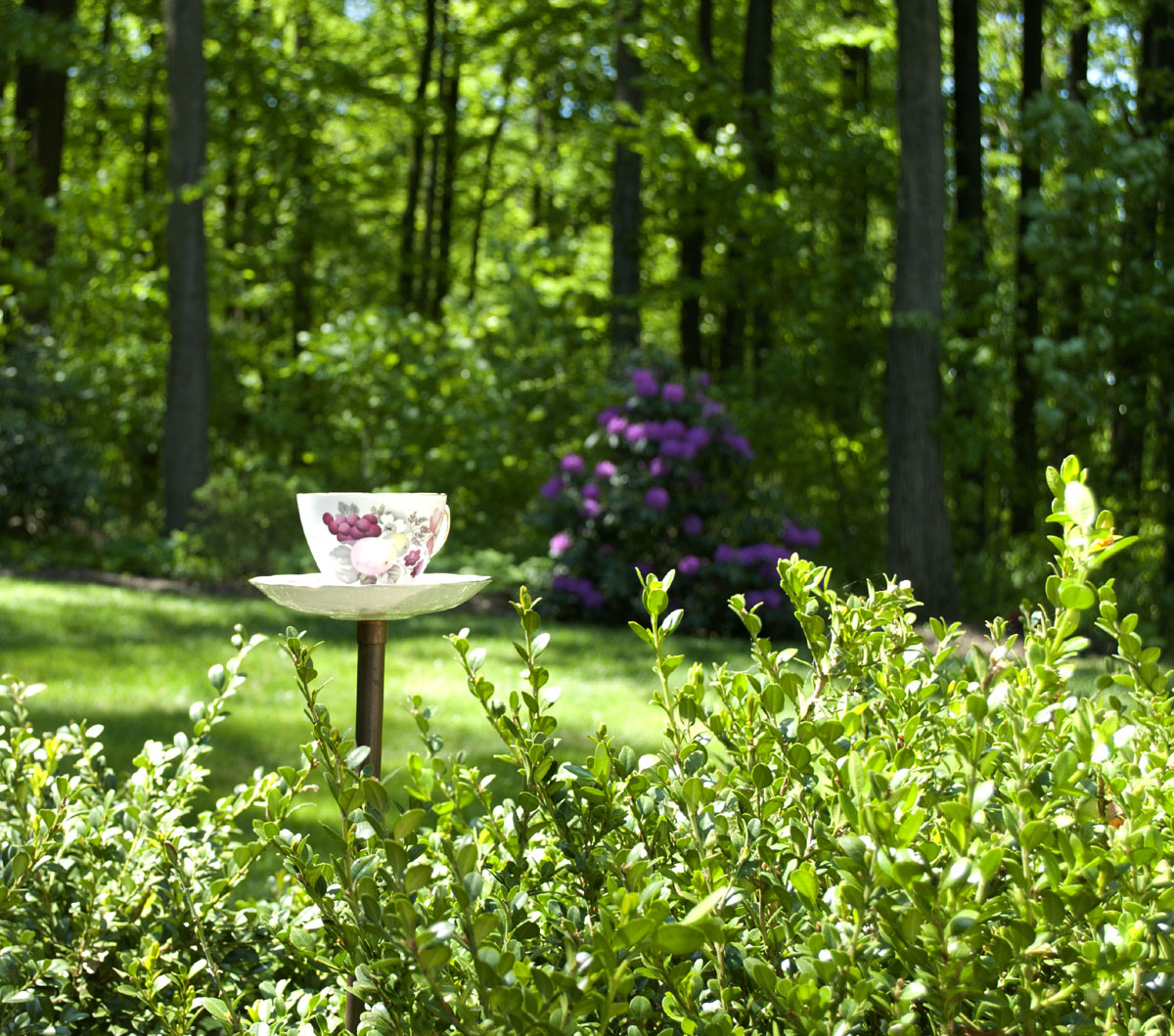
Catbirds take a bath in our garden teacup daily. 

I felt like a dunderhead. I was, however, a motivated dunderhead. The more I dug, the more enthused I became. Charlotte Mason supplied me with the "how-to" and the "why-to." I recognized that her books in my hands were a gift from God, a generous answer of prayer. Slowly and gradually I grew in understanding. Did I understand everything I read? No. Ideas take time to germinate, time to be contemplated, to be worked-out, to be lived-out. Ideas can't be rushed. Eventually, we find our feet by walking in them. The ideas become a way-of-life. It's the educational life.

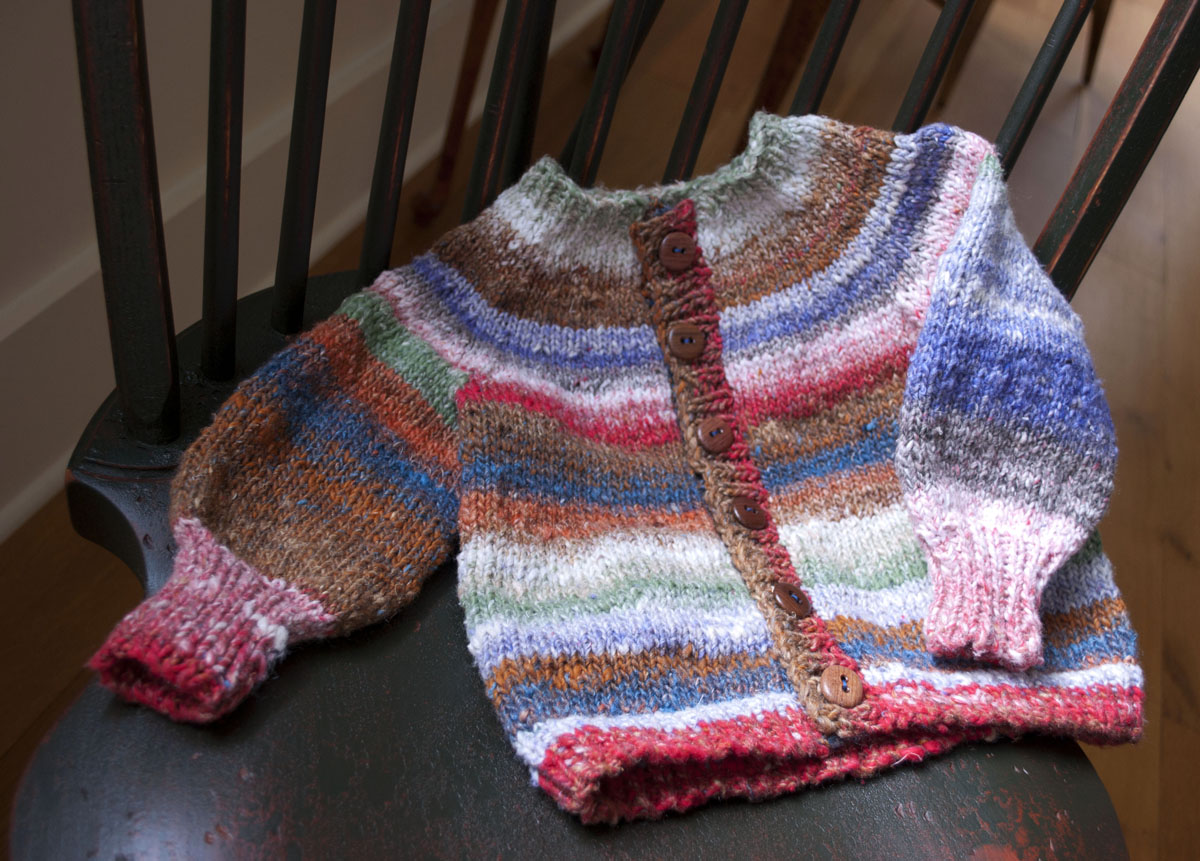
Knitting this yoke pattern for Eloise was a dream. It has 8 stitches to weave under the arms and no other seams. 

I've noticed something. Charlotte Mason's principles fit different circumstances beautifully. The people applying them are of different financial means. They have different backgrounds, different personalities, gifts, talents. They even live in different parts of the globe. Some with English their second language.

Miss Mason's principles are not just for the well-to-do or the well-prepared. They aren't solely for the intellectual. My husband Dean told me Miss Mason's principles are basic enough for even simple people (like us) to understand. She reached out to the poorer (less-literate) classes as far back as when she gave her lectures in London in the 1880s, and thereafter. I can relate. I was Less-literate with a capital "L".

Johnny-jump-ups with pansies. Potted herbs behind. Outside the kitchen door. 
Margin
Miss Mason's ideals are high. I craned my neck looking up. But it is a road worth walking no matter what situation you are in at the start. However others carry-out the method today, however well-accomplished the PNEU was in its hey-day of the 1930s, you are left to personally to find your feet. Please give yourself margin my friend. With respect to the person God is making you to be, respect your personal application.

Weigelia and Dianthus along our garage-shed.


On page 38 of School Education Miss Mason invites teachers to recede. Teachers are to make room for students to "feel their feet" with what they are learning.

We inspire. We set-in-motion habits and skills. Then we recede. This way we do not continue to indefinitely "carrying them through their schoolwork." Rather, we give them margin while we set their feet in a land-of-opportunity. Self-education is the result.

The same can be said of mothers.  Home teachers are learners, too. Are you giving yourself margin? Let's be courteous. Let's give each other margin.

Dean says, "The Charlotte Mason Method shines brightest when we allow ourselves the freedom to adapt Miss Mason's philosophy to our own individual domestic circumstance. We are, then, free to be ourselves before God and our children."


Some seek exact recipes. By focusing on the letter-of-the-law, however, we can miss living by the spirit-of-the-law. A mother misses the joy of learning with her children when choosing exact recipe over personal application. Miss Mason's principles are living principles meant to be a blessing.

A Mixed Bunch 
Weigelia and Dianthus along the garage-shed, close up.
We are a mixed bunch of Charlotte Mason followers. I know because I've had the pleasure of meeting some of you through the mail.

One family fills a handful of notebooks on various subjects. You're impressed. Your family started one or two. These notebooks are half-filled by the end of the school year. But they are handsomely half-filled. This will do. Each notebook represents happy days of curious and focused learning.

One mother reads Plutarch annually. Another mom prefers to read a little Plutarch if any, especially as she has shelves of carefully collected juvenile biographies filled with "lives." Such a quantity of lives for children was unavailable in Miss Mason's day. Go for it.


My new little quilt of scrappy "Broken Dishes" beside the Dianthus.
A pastor friend of yours, who lives an hour away, had his children memorize Shakespeare. He sends you an invitation to the performance. You take the drive to "hear" and see his students perform The Tempest. It's thoroughly enjoyable. Your family has appreciated Shakespeare. But directing a full-length play isn't an undertaking for you.

All 5 of a family's children play a string instrument. Even the 4-year-old takes lessons. Private lessons aren't in your budget. But since your eldest babysits she can help pay for hers. The younger children must wait their turn to start. They like hearing Big Sister play and look forward to when they will start their lessons.

One mother's student receives a lesson in Latin from his father daily. You tried Latin but it tipped the scales for you when your 6th child was born. And someone has to get a healthy supper on the table. Your husband isn't likely to teach his children Latin. Even if you ask him. He bought his boys catcher's mitts and enjoys playing ball with them out back. "Just what they need," you're thinking as you watch their energy through the kitchen window, "a good work-out." You offer a prayer of thanks while peeling the carrots.


I enjoyed lining one garden with seashells I beach-combed  years back. 

One mother teaches her little ones Sol-fa. It is important to her that they are brought up to sing well.  An elderly man in church is stricken with A.L.S. Mom, Dad, and the children visit him one or two Saturdays a month. The little ones sing for the man they affectionately call "Grandpa." The tears in his eyes show how touched he is by this gift of friendship. He has no grandchildren of his own to visit him. Your children can carry a tune. It's a joyful noise.


One family has traveled miles to the Creation Museum. The ark was spectacular. They've also taken physical-geography-walks. Their interest in rocks, fossils, dinosaurs, and land formations never seems to wane. They tell you about their experiences excitedly. You're glad for them. But you can't see your family traveling that far anytime soon with a van that needs frequent engine repair. The Nature Trail at the edge of town is a hike your family enjoys. And some books from the library-discard-sale are proving insightful.


Wooden Buttons The Yarn is Noro silk/cotton with slubs.

Keep Your Focus

While you are finding your feet you can't help see what others are doing. But you can open your eyes wider to what you are accomplishing. Look at what you can do. You are faithful to get up every morning to do it. And if it isn't done as seemingly radiantly, or as grandiose, as others. It doesn't matter. Your gifts, talents, interests are being used in your family. They are radiant. Because no effort, no love, no good work, is invisible to God.
My fieldguide says this is a Fleabane Daisy. I learned something new.

Part Two on this topic is upcoming.

Well done my friends.
Karen Andreola


Sunday, February 26, 2017

Glow of Intellectual Life

Glow of Intellectual Life
(an alternative to burn-out)

A little phrase in Miss Charlotte Mason’s writing popped out at me. I thought, here’s a reason to rejoice. I highlighted it in yellow. Later I underlined it in green. The 60 years Miss Mason was in close contact with countless children gave her a keen understanding of how they learn. Combine the right atmosphere, books of literary quality and regular opportunities to digest them, and a child’s face will be radiant with the glow of intellectual life. *1 It is wonderfully true. I’ve seen it work. Have you?

Granddaughter wearing Grandma's kitted purple pinafore

Years ago, I read the lecture that the mystery novelist Dorothy Sayers, delivered during vacation-school in Oxford in 1947. Educators in America today refer to this lecture as being a kind of classical approach. In this lecture, Dorothy Sayers starts out apologizing for not ever having taught children. Her opinion is based on a reasonable historic premise that dates back to the Middle Ages and seems lofty, somewhat stiff, and impressive. Yet, when you get right down to it, her opinion is really supposition – what she assumes (without experiment) to be the best possible way to educate children.

After being persuaded to follow the advice contained in Dorothy Sayer’s ten-page essay mothers are experiencing burn-out. The children are, too. Mothers who end up writing me claim so, that is. Therefore, when a mother also shares with me that she has decided to turn another leaf, back to the approach and the lady who first inspired her, Charlotte Mason, I always cheer her on. Welcome back.

News reached my ear again over summer (and recently). Giving the young mother anonymity I am sharing the gist of it. I hope to guide any who are in a similar situation or – quandary.

Dear Mrs. Andreola,
I dropped out of a classical co-op. Because of the thousands of dollars it cost me I stayed in for the year. In hindsight, I could have dropped out sooner. But my son liked the games. My daughter liked seeing her friends. I felt less lonely. Now I’ve lost my friends. Some aren’t returning. They’ve decided home teaching is too stressful and they’re putting their children in the government school. Yikes.

I should have known better. I read your book, A Charlotte Mason Companion before I got involved and even started reading Charlotte Mason’s books. I’d like to make new friends. I haven’t found any yet, though, who follow what you describe. In my heart-of-hearts I want to see Miss Mason’s ideas through.

I guess I gave in to fear. I thought I needed to heap more memory work upon my children’s heads. I was afraid, along with the other moms, that my children wouldn’t do well in college unless they had the superior advantage that only memorization can give – supposedly. All school year we put in the effort. We kept up the memorization, covering and re-covering lists, facts, names and dates. We spent less time with living books, very little time outdoors observing nature, appreciating art and good music. I wish I had never signed up. For all this exhausting effort all I feel is burn-out.

Thanks for listening. If you could give me some advice I would appreciate it. Feeling alone, Anonymous.

My dear,
Anything we do differently than large groups of people can feel lonely. I remember my loneliness. Here’s some good news. You have more of an opportunity today of meeting parents who have chosen the Charlotte Mason approach to education, than I and many of my readers had, 30 years ago. Friends have spread her ideas far and wide.


A Quilt of Flying Geese - My latest Mother Culture Project

Walk by Faith, Not Fear
When a mother worries that her children aren’t covering enough—or fast enough - anxiety hangs in the air. Anxiety wears a mother down. It disturbs the atmosphere of learning. It is natural to want children to learn. But love and faith must be stronger than our fears. Without faith it is impossible to create a peaceful, pleasant intellectual atmosphere.

Fear is a strong motivator. It definitely gets things moving. Like the sting of the whip that quickens the horse, fear motivates the teacher. It is also used to motivate children. It is used in schools today, though more subtly than the Victorians used it, when it was common for a child to receive a caning of his fingers as swift punishment for a blot of ink on the page of his copybook.

The Child is a Person
A child is not one of Pavlov’s dogs or merely a subject for Skinner’s behavior modification. He is not a memory-machine, either. He is created in the image of God. He has a soul. Education is a spiritual matter. [It is] by knowledge one grows [and] becomes more of a person.*1


Hand-quilting around the leaves

Faith in Something Big -Curiosity
To educate by faith it is helpful to understanding that God has endowed our little persons with curiosity. They are born with an appetite for knowledge. It is calming when we stop to consider how large a part curiosity plays in a child’s learning.

It is not the only feature, but it is capable of doing the lion’s share of the teaching. For instance, throughout the day a 2-year-old can be heard to ask, “Wus tha?” as he points to one object after another, for the pleasure of hearing his mother name the bird at the feeder, the rain on the windowpane, the car in the driveway. His mother is, in a sense, cooperating with curiosity. She is cooperating with the work of the Holy Spirit in the child’s life.

Miss Mason refers to the Holy Spirit as the Divine Educator.


Curiosity is so precious, so valuable a player in acquiring knowledge, that it needs to be preserved. You might even say, “pampered.”

Sadly, this precious feature of childhood is seen as something insignificant. Therefore, it is squashed - as if it were nothing but a pesky bug. How? When an inordinate amount of time is given to memorization. Then, we reap what we sow. “We get a narrow, accurate, somewhat sterile type of mind,” says Miss Mason.*2

Curiosity cannot thrive when the emphasis is on rote memorization. It withers away. Therefore, with curiosity so withered children are inevitably made to be motivated by:

• Grades


• Prizes and Contests


• Competition


• Fun and Games


• Praise and Approval


• Punishments


• A Profusion of Quizzes and Tests

“A school may be working hard, not for love of knowledge, but for love of [grades], our old enemy . . .”*3 The above incentives all motivate the student to work, but his work becomes mechanical. For instance, he will study for an A on a test even if it demands midnight cramming for what he soon forgets.

“Then, young faces are not serene or joyous but eager, restless, apt to look anxious or worried. The children do not sleep well, and are cross: are sullen or in tears if anything goes wrong, and are generally difficult to manage.”*4

“We foresee happy days for children when teachers know no other exciting motive . . . is necessary to produce good work in each individual of however big a class than that of the love of knowledge which is natural to every child.”*5


Tiny snow drops beside the basement doors.

Expanding Horizons with Ideas
Memorization is a tool for learning, yes. But it must never supplant or supersede a life of ideas – especially in the early years of a child’s education. If the child is a person, he must do the work of a person - not a parrot. We owe it to our young people to expand their horizons, to give them new ideas to think about, to lay out for them wide open fields of study.

“Astonishing fair things will grow in that garden of mind in which we are invited to sow the seeds of all knowledge.”*6

Children trained by the Charlotte Mason Method linger with knowledge, for sake of knowing, for the sake of growing - in wisdom and favor with God and man.


You can place your trust in the following list also. These things will not be new to you. I am reminding you of those things you say you originally held "in your heart-of-hearts."

Trust in Your Calling
The Majesty of Motherhood is a concept that is meant to leave you with a strong impression. You are the queen of your household. The day your little one was placed in your arms was your coronation day. You were crowned with authority from God and are accountable to God. Your duty is to rule with a firm, loving hand while understanding the nature of children. Your children, in return, are to honor and obey, cheerfully.


Trust in Your Children
When hunger is satisfied by wholesome intellectual food children will delight in lessons. Then, you will see signs of a reawakened curiosity, and a quiet contentment. Reach for those library books that are nestled in the basket by the sofa. Read about the kinds of things your child has a desire to know. Open your field guide to identify the living things that surround you.


Trust in Living Books
We are not educated by memorization. Miss Mason says that we are educated by our intimacies. It is important to note that knowledge-made-personal and information-memorized are two different things. The typical schoolbook (especially the memorization of it) with its dry factual treatment of a subject, was one of the first things Charlotte Mason found to be a stumbling block to curiosity. A living book enlivens the child’s mind with ideas.

Using books of literary quality enables students more brilliantly tell in their own words what an author is sharing. This is the impression-expression of an intellectual life. Rather than note-taking for tests, hearing lectures whereby a teacher’s explanation does the thinking for the child, Miss Mason let the children connect directly with the mind of an author. She says, “Let the lessons be of the right sort and children will learn with delight. . . . The children must do the work for themselves. They must read the given pages [once through] and tell what they have read, they must perform . . . what we may call the act of knowing.*7

Trust in Narration – the Art of Knowing
Give memorization a lower seat of important. It is far better to require the child to use his whole mind rather than be wearing down the grove of a narrow part of it. Narration is no “parrot-exercise,”*8 says Miss Mason. To narrate, to tell the passage in one’s own words, takes the place of memorizing names and dates, multiple-choice quizzes, and questionnaires.

As he forms his narration, a child ponders. He forms a train of thought; he digests, sorts, summarizes, he sequences events, etc., as he reflects upon the reading – without a teacher’s meddling. This “act of knowing,” is a kind of self-education. It is deliciously satisfying. The teacher may highlight the names and dates from something read (once through only). Then, require the student to tell the history (story) passage in his own words - using the names and dates indicated. The student will be using his own mind - with a cohesiveness that makes the names and dates meaningful and memorable. To ponder is better than to parrot.

Trust in a Wide Array of Subjects
The long hours some are dedicating to memorization (claiming it to be the Charlotte Mason approach) is startling to me. Miss Mason insisted upon a wide curriculum. This wide ground can only be covered by keeping lessons short. With short lessons optimum attention is achieved, especially with what she calls the disciplinary subjects, such as math, spelling and grammar. You’ll have time to transition, to alternate lessons with Bible, poetry, history, fiction, art, folksong, outdoor nature study, recess, chores and life skills like cooking, to keep minds bright (and allow for freedom of movement). It isn’t the number of subjects but their duration that tires the mind (and makes a sedentary body). We did a quick math drill every morning and a review of the same facts before supper. A better memory of facts was the result. Memorizing Scripture (which is the living Word) or poetry (which opens the eyes of imagination) verse by verse takes minutes a day. Scripture and poetry also warm the sympathies. They are not dull, dry facts alone.

Trust in the Discipline of Habit
Habit draws us forward to do the “next thing.” Children will readily do what is customary. “I can see how practical good habits are,” one mother shares. “When math is completed, the children always look forward to a mid-morning snack, then to hearing an episode of history. After this refreshment, spelling is tackled automatically, with drawing anticipated next.” During the first months of homeschool this mother made every effort to keep to a regular schedule of short lessons. Now, with less effort, habit carries her children smoothly and pleasantly through their morning schoolwork, more smoothly than at the start of the year. Prizes or punishments are not necessary for a result of work well done.


In Conclusion
With the 3 tools of teaching; Atmosphere, Discipline, Life of Ideas, we usher in the blessings of the intellectual life. A calm and contented intellectual glow can be seen on the faces of teacher and children alike. Over-much memorization results in intellectual feebleness – Miss Mason pointed out. Such undue emphasis is unknown in homes where her philosophy is tried.

I close with Miss Mason’s beautiful words:
“The bracing atmosphere of truth and sincerity should be perceived in every school; and here again the common pursuit of knowledge by teacher and class comes to our aid and creates a current of fresh air perceivable even to the chance visitor, who sees the glow of intellectual life and moral health on the faces of teachers and children alike.”*9

Children brought up by Miss Mason’s method do enter college and do well. I’ve seen this first-hand and brought this up in an earlier post.

Thank you for writing,
Karen Andreola

End Notes from Charlotte Mason’s Philosophy of Education


*1 pg 325


*2 pg 277


*3 pg 97


*4 & 5 pg 98


*6 pg 277


*7 pg 99


*8 pg 273


*9 pg 97


Sundry photographs taken at Landis Valley on Dean’s phone this February.
You can write me at karenjandreola@gmail.com


Tuesday, January 24, 2017

How do you like school?

How Do You Like School?
My sleeping herb garden out the back kitchen French doors.


Winter has settled into a routine. I’ve been ministering to my family. Dean’s mother went to be with Jesus. Some of the extended family gathered here for hugs, to remember Mom and to watch old family-movies taken by Dean’s grandfather in the 1950s. Sweet memories.

This post is a gentle warning.
Gentle, because I omit the list of terrible snares that young people are falling into today. But it is a warning, just-the-same.

Three days a week, I do physical therapy exercises, here at home, in my efforts to manage the chronic pain of peripheral neuropathy. Best of all, P.T. has enabled me to bend my back far enough sit on the floor and play with my littlest grandchild. And I'm able to keep our baseboards free of dust.


Morning sun gives the best light for dusting yards and yards of baseboards. 


While I exercise, I listen to Christian radio. Between songs is a two-minutes broadcast for parents and youth leaders. Like-it-or-not, I’ve been made aware of the multiplicity of problems that exist in teen culture today. I said to the Man-of-the-House, “How can I bear listening to yet another broadcast about youth culture? It's horrible. It's overwhelmingly sad.”

What makes it upsetting is that we know teens who are experiencing these dark attitudes and behaviors. Their parents have asked us to pray. I’ve done so with a heavy-heart this winter. I've also acted outside my comfort zone. Earlier this month, I typed a letter in the “Contact Us” window of CPYU Center for Parent/Youth Understanding, the ministry that provides the two-minute radio piece and a newsletter. I've never done anything like this before.

Here’s the gist of it.


Dear Sir
I've been hearing Walt Mueller's excellent short, informative pieces about youth culture, on the Christian radio, for nearly 2 years.

I'm old enough to have witnessed results of teens who attend public high school. Even teens who sit in youth-group every Sunday falter morally. The social engineering of the leftist-agenda/curriculum, as well as the peer-hierarchy-environment, along with hours spent with sensational entertainment/media, seem to be insurmountable influences. 

The little quilt is called "Cherry Baskets" and will one day be for a granddaughter.
Statistics claim 80% of children of Christian parents do not return to the church. Is it that they do not come to know our loving Savior in a personal way? Do they not see the need for Christ’s atonement for their sins while young? Or are they pulled in too many directions? Anyway, it's heart-breaking for parents. We know because some have shared their deep sorrow with us.

In the 1970s my husband was a youth group leader. He saw how little involved parents were with their teens. They didn’t seem to know them. Thus, they heavily depended on others for bringing up their children, and for leading them to Christ.

Forewarned, I decided to home teach ours. What have I observed over 30 years? I’ve noticed within my circle of friends, that the biggest problems of youth culture are happily absent in children home taught through high school.


1) High-school-age homeschool students have acquired the habit of self- education. They are not bored. 

2) They are well-read and express themselves with clarity, orally and in writing.

3) In humility their ears are open to the counsel of the Word of God.

4) Joy and reverence are attitudes that accompany their walk with God.

5) They maintain a close relationship with their parents and siblings.

6) They are comfortable relating to people of all ages.

7) They smile and have a sense of humor.

8) They understand the true meaning of "courtesy" found in the Golden Rule of Jesus. They practice purity in preparation for marriage.

9) They are patriotic and know their history.

10) They entertain wide and varied interests - (commercial and volunteer) - interests that have little to do with teen-fads – especially fads that are self-destructive, dark and dangerous. And they are not afraid of a little hard work. 

Home educating families do not live in isolation. Networking, support groups, conferences, co-ops, orchestra, field trips, etc., are accessible in many communities. Home-taught-teens have opportunities, too, to look outside themselves with acts of service, such as baby-sitting, singing or playing an instrument at a nursing home, etc. A short hop on-line will show what modern research reveals about homeschooling. One article (unintentionally) debunks the misleading stereotype of the homeschooler: "18 Reasons Why Doctors and Lawyers Homeschool Their Children" by Kathleen Berchelmann, M.D.

I enjoyed all the hand-quilting I stitched into it of a comfortable size. 
Won't you make homeschooling one of your helpful suggestions for Christian parents sometime? It has such immense advantages that I don't understand why it is ignored. Why keep homeschooling a secret? It is a wonderful alternative to the pressures and perversions of public school. Perhaps you have already addressed it somewhere at CPYU but I’ve missed it. We've seen that sending teens off to be immersed in the highly captivating youth culture of public school (of which you speak) is a situation greatly counter-productive to whatever little time a student and parent have left-over to discuss the Biblical worldview, etc.*1

What did our Lord Jesus say about the children (who are on loan to us)? "Hinder them not." Therefore, should we immerse them in a youth culture that is grounded in a godless-mindset that would be a stumbling block for them, while thinking: It won't happen to my child?

My dream was to knit a pinefore for Eloise. I saw this realized this January.
 Perhaps, some spiritually mature teens do survive. But my husband says, for every one that seems to come out okay, a hundred do not. I am so saddened to see how teen culture has found its way into the church, that I had to write CPYU. I've been listening to you. And the myriad of gruesome problems that parents are suppose to be aware of and/or talk about with their teens. Thanks, this time, for listening to me.     Karen Andreola

I like this in-the-round seam-free pattern. I went bananas over the cute ruffle. 
 [Addendum: I received a reply with the perspective of CPYU shortly after my letter was read.]

 Too Polite
“How are things,” I asked a mother several years ago. We stood in the church hallway. She looked nervous.
 “Oh, you haven’t heard? Barbara and Greg (not their real names) decided they wanted to attend public high school to be with their friends.”
 “No, I haven’t heard,” is all I said, trying to keep my smile-muscles from weakening. My private thoughts were, your children decide what’s best for them? And, this is placing a very high priority on friends.

I finished hand-quilting my Northern Star quilt in William Morris fabric. 
I had this same sort-of-conversation with another mother who told me her children decided they wanted to attend the big public high school. In both instances, I stood staring, dumbly until the subject was changed. After all, I thought, my opinion isn’t being called for. I was too polite. I bit my lip. And now I wish I hadn’t. I could at least have posed two questions. One about peer-pressure/counsel. The other about the atheist/socialist-curriculum/counsel. I wish I could report the years proved my forebodings incorrect about these children. What can be sadder for the parent who discovers his child is walking in the counsel of the ungodly? *1

The Man-of-the-House read what I've written here (before I posted it). He told me that if even the mighty among us (highly-educated pastors and leaders in ministry) fall. Why do we think our fragile, impressionable young people would be immune to temptation in an anti-Christian environment?

This bird I "fussy-cut" is my favorite of the stars. 

How do you like school?
 A modern survey reveals how students feel in public high school. The top 3 responses were:

tired, 
stressed 
and bored.*2

Charlotte Mason says that if children do like school, it is usually for the wrong reasons. They don’t like school because they find it interesting. Or because it satisfies their craving for knowledge.

 If children like school it is because:

 . . . they delight in the stimulus of school life, in the social stir of companionship. They are . . . eager for reward and praise. They enjoy the thousand lawful interests of school life, including the attractive personality of such-and-such a teacher. But it seems doubtful whether the love of knowledge (in itself and for itself) is usually a powerful motive with the young scholar. The matter is important. Because, of all the joyous motives of school life, the love of knowledge is the only [lasting] one; the only one which determines the [measure] . . . upon which the person will hereafter live.*3

 Miss Mason also recognizes that:

 “. . . by far, the most valuable part of education is carried on in the family . . .”*4


I pinned it to the wall in the upstairs hall landing. Stairs at left. Window, right.

I think this has been true, and will be true, in every century.

Two of our grandchildren (homeschool-kids) walking back from their mailbox. 

 “Blessed is the man who does not walk in the counsel of the ungodly . . .*5

Comments are Welcome,
Karen Andreola

 End Notes
*1 Mathew 7:13,14 is one of many reasons parents home-teach through high school.
*2 USA Today “Our High School Kids: Tired, Stressed and Bored.” Pub. Oct., 2015.
 *3 Charlotte Mason, School Education, pages 245-246,
 *4 Ibid, pg 94
 *5 Psalm One is another reason.