Showing posts with label Film. Show all posts

Monday, April 13, 2015

How to Overcome a Modern Disadvantage to Learning How to Read

How to Overcome a Modern Disadvantage to Learning How to Read 
 (article length)

I am probably preaching to the choir (again.) But from the comments I’ve received over the years, I know you don’t mind.


On the first warm day of spring the Man-of-the-House treated us with frozen custard at “The Meadows” in Strasburg. Their custard is rich and creamy-scrumptious. Near the ceiling of this little ice cream parlor is a wide-screen TV. While my scoop of rich vanilla was disappearing I said, “Oh, this must be one of those house make-over programs. My menfolk looked up and nodded.

I watched. A man spoke a few words. Then scenes appeared in lightening-sequence. The new owners were demolishing the old kitchen cabinets. Splintered wood crashed to the floor in a cloud of dust. A moment later the wife was picking out wallpaper and paint colors. “What was that color they chose? I didn’t catch it,” I said to my menfolk. “I guess I’ll find out when the show starts.”

“Mom, this is the show,” my adult son said.

“You mean this isn’t the sneak-preview introduction?” I queried.

“No,” he said. “It’s the way shows are made these days. Everything flickers and flashes. I can’t watch it.”

“Neither can I,” I said, disappointed. It jarred my senses. I turned my attention to my melting custard and gazed out a window at the blue sky over the parking lot. 

“How do they film it?” my son wondered, thinking out loud. He was already crunching on his cone.

“Good question,” I said, “It must be a piece-of-work to cut and paste all those separate segments rather than rolling the camera.”

The Man-of-the-House added, “Rolling” is a word associated with film-making of the past.” I felt old.

Today, children aren’t watching the camera roll. What is being made for them (for all of us) is a choppy presentation of individual images on a screen. And with computer games children themselves are in control of the fast-paced animation – a deeply satisfying experience of creating the next and next new experience - a continual feast of novelty. 

I sympathize with this generation of home teachers. Never before has there been such a big disadvantage to teaching a child how to read. The disadvantage is in the form of a multiplicity of irresistible screens. Yet, beautiful books and quality audio are in abundance. Can screens affect the ability of a child to focus on lessons? Children naturally learn at different paces even without any such thing as screens but those who closely study how children learn say “yes.” They see a correlation.

a disadvantage to reading

A lack of focus and ability to remember are symptoms of a child spending regular time riveted to fast-paced entertainment. Many television programs and computer games grab attention by a heightened sensory experience. The viewers give involuntary attention. Attention is seized by exaggerated animation – portraying a distorted use of force (slapstick), bold sound effects, dazzling explosions of color, blasts of music, a wide range of emotions – all in a cacophony of vignettes that change hurriedly. It might be surprising to learn that among all this busyness brains are passive while the screen is active. Furthermore, when children are acclimated to the over-stimulation of screens they are set on habits that are antagonistic to academic learning.

Voluntary attention is the kind needed to learn how to read. Dr. Jane M. Healy says,


“Reading involves sustained voluntary attention from a mind that can hold a train of thought long enough to reflect on it, not one accustomed to having its attention jerked around every few seconds.” *1


In comparison to viewing, reading is a slow business. It isn’t instant access to ideas or instant gratification. Accustomed to the “instant” a child may be restless at lessons. He gets impatient with himself. He gives up if he doesn’t immediately get it. Ideas picked up from reading do not seize the reader’s mind like entertainment does. Words on a page stand still. The very fact that they are stationary and not calling attention to themselves make it difficult for some children to focus.

A Skill Developed in Slow Tempo

children's early readers
Photograph by Michael Drummond

The early readers I gave my children have one sentence per page and one picture. The words and pictures are stationary. But the characters are active. A mini plot unfolds with action. A sort of animation is encouraged and launched in the mind of the reader by the vivid verbs in the sentences. Described and pictured in the story might be a dog with its snout wide open, barking at a cat. A boy runs making energetic strides in mid-air in his brand new sneakers. Dad hammers nails as he builds his children a tree house. The children, all smiles, climb into it. They also ride bicycles, throw snowballs, blow out candles on a birthday cake, etc.

With each reading lesson an important critical skill is gaining power. I don’t mean the decoding of phonic blends or the recognition of sight-words (although this is necessary work, too – and basic). The skill I’m talking about is imagining. With each lesson the ability to imagine gains power. This important skill is what holds the interest of a reader – at this slow tempo. The fruit of this skill, developed by slowness, is mental perseverance.

Imagination-animation

Screens make the power to imagine unnecessary. All the work is done for us. With reading the act of imagining not only keeps the reader connected with the text “but also it is a very practical way to keep track of and remember what has been read.” *2 This is why reading aloud to children, for some years prior to reading lessons, is immensely helpful. Children need lots and lots of good slow exposure to language. It starts them developing their powers of imagination as their minds create pictures from the words read to them – pictures other than those in the picture books. It gives them experience at projecting things and animating things - on “the screen of imagination.”*3

Later children will read books with no pictures. Living books for history and science as well-written fiction, will contain sensory language: words and phrases that describe action, sounds, colors, smells, textures, and emotions. All this must be interpreted by our brains in our imagination.*4

Some children have the ability to bend their brains around the written word, easily. It magically makes sense. They piece together phonic clues, nouns, verbs and pictures, within the grammar of a simple sentence. Others, including bright children, have a hard time of it. Readiness and ability vary greatly. Susan Schaeffer Macaulay says that reading lessons “should be carried out in a friendly, quiet, regular, and structured way. A child should never be made to feel that he is lagging behind others of his age.”*5

Patience Does More Than Push

Turning seven - Maryland - April 1996

Given the same lessons some students, boys for one, will crawl forward and not without much effort. Such was the case with my son. (I had taught two girls before him.) Patience was my friend. Practice was his. But it must be interesting practice. I remember sitting beside Nigel on the sofa daily, listening to him read aloud, around the age of 7 to 8. I tried not to sigh or interrupt (unless I was asked a word). I tried to not let my thoughts race ahead to all the many other things needing attending-to before lunch. I sat back comfortably and enjoyed the experience. He took his time within a reasonably short lesson. He could relate to the characters and plot of the little story. They held his interest. The sense of accomplishment he derived from his effort was a quiet happiness for both of us. From what has reached my ears over the last 30 years this crawling-issue with boys is not uncommon – even up to the age of ten or so. Slow is a legitimate "way to go."


Miss Charlotte Mason says,

We forget how contrary to nature it is for a little child to occupy himself with dreary hieroglyphics – all so dreadfully alike! – when the world is teeming with interesting objects which he is agog to know. But we cannot excuse our volatile Tommy, nor is it good for him that we should. It is quite necessary he should know how to read; and not only so – the discipline of the task is altogether wholesome for the little man. At the same time, let us recognize that learning to read is to many children hard work, and let us do what we can to make the task easy and inviting.*6


Limited Animation - A Step-down

In the pre-computer, pre-gadget days, I learned that television had an affect on a child’s ability to focus during lessons. Therefore, I was careful. I rationed screen-time like I rationed sweets. I developed ear-skills over eye skills with reading aloud, conversation, singing, music and audio. And the outdoors was a sensory experience for them.

http://www.amazon.com/The-Wind-Willows-Complete-Series/dp/B0007GP82W/ref=as_sl_pc_ss_til?tag=charlottem0a5-20&linkCode=w01&linkId=MHSJJQIPKWVNHMK4&creativeASIN=B0007GP82W

When we lived in England (1980s) my little girls watched limited animation such as the early BBC TV Postman Pat. Years later my son watched the early Thomas Tank Engine videos narrated by Ringo Starr. Both of these (stop-motion) programs have since been “improved” for modern viewers. A favorite of ours is the British clay-mation film Wind in the Willows (based on Kenneth Grahame's classic story). We enjoyed, too, the television series with further adventures made up about Mole, Ratty, Toad and Badger. We had books with all of these story characters.


http://www.amazon.com/Postman-Pats-Tractor-Express-Pat/dp/059070320X/ref=as_sl_pc_ss_til?tag=charlottem0a5-20&linkCode=w01&linkId=7D56MZUM3KLPENHQ&creativeASIN=059070320X

Although they are becoming rarer in the U.S.A. you can still find copies of Wind in the Willows and The Tales of Beatrix Potter (another favorite of ours) on DVD. (Look for versions that are region 1 - U.S.A. compatible). Beautifully produced these programs are a decided step-down compared to today’s techno utopia.

When the children were older on Friday evening we'd watch an old movie together as a family – with popcorn. If you asked my children what Saturday morning cartoons are, they couldn’t tell you. Although I tried to use video sparingly I was discrete. I followed guidelines I made up for myself. It was just how we lived.

Arm Yourself

bored children, creativity
In March our grandsons were digging for diamonds in their front garden.

You might decide that you would like your child be more screen-deprived than he is. Consequently, he may experience symptoms of withdraw.

First, arm yourself with the notion that it is okay for people (adults and children) to be uncomfortably bored, even bored stiff.

Second, it is okay to make messes. Cleaning up afterwards is a worthwhile activity too. It’s training in orderliness.

Active, creative brains bounce back and forth between boredom and creativity.

A list of alternative activities will suggest themselves to you. Recently, the Man-of-the-House and I were driving along a country road between two wide fields. The wind was blowing steadily across them. “This would be the perfect place and the perfect day for a kite,” he said. I agreed. When we returned home I decided kite-flying would add a light touch to the end of a serious article and found a painting by John George Brown. His children seem to have kite-flying-clumsiness in common with Charlie Brown, don’t they?


End Notes
Lavender Sachets
*1, 2, 3   Jane M. Healy, Ph.D., Endangered Minds – from the insightful chapter: “Sesame Street and the Death of Reading,” pages 231, 232.

*4  Exercises in recognizing and writing with sensory language are provided in my book Story Starters – for 4th grade up to high school.

*5  Susan Schaeffer Macaulay, For the Children’s Sake, page 36. I have an autographed copy.

*6  Charlotte Mason, Home Education, page 214 The chapter on reading could be quite helpful to you.

Lavender Strawberries
Here you see Stacey’s Lavender Strawberry Sachets. Her mother sent her a kit for Christmas. It looks like Stacey is getting ready to make another set of sachets with the pretty fabric on her table in colors also in keeping with springtime. Thank you, Stacey, for sending us your photograph. You’ve brightened my day.

Feel free to share my article with this generation of concerned mothers.
If you like to read product reviews see below.

Until next time,
Karen Andreola 

Captivated – finding freedom in a media captive culture

Review by Karen Andreola

After viewing Captivated several years back and reviewing it for CBD I went on a buying spree. I bought a quantity to share. I’ve since given them all away.

Its message urges us to establish screen-time guidelines. Technology is a good thing but caution is needed. Christians and unbelievers alike are recognizing the powerful pull media has over the behavior of young children, teens and adults. The influence of screens, media and gadgetry is stronger than we like to think. Beginning with our littlest and most impressionable children it can quickly produces both aggressiveness and inattentiveness. It can distract teens and adults enough to mar productivity and hinder spiritual well-being.

If we humbly look how captivated we’ve become by screens we’ll be more open to heed the warning to control them so that they do not control us. Authors, pastors and people in different walks of life, reasonably and candidly share why to unplug. Although many a tragic story of serious addiction could be told, it is not told here. In this message reason, not sensationalism, pleads with us to make choices – big or small.

Media can drive a wedge in relationships as it isolates us in our own little worlds. And yet, seeing the faces of our friends on-line makes us “feel” sociable. How far we’ve come from the days of neighborhood play and of talking over the fence.

After listening to the comments in the extended interviews a conviction arose in my heart. I sought to make application to my own life. I enjoy visiting blogs and window shopping online but chose to unplug at least one or two days a week. May the message of Captivated be a blessing to you.


Sunday, December 7, 2014

Home For Christmas by Karen Andreola

Home For Christmas

 "I'll be home for Christmas, if only in my dreams."

This old black and white photograph shows where my husband, Dean, started his life. The house is an iconic picture of an American home. It sits on West 7th Street in Plainfield, New Jersey on two-and-a-half acres, among streets of architecturally interesting Victorian houses both small and roomy - mostly roomy, built for the large Victorian families that once lived there. Plainfield was, in those days, a safe and beautiful place to live. And convenient. The train took its residence into New York City. The Gilbreths of Cheaper by the Dozen had lived in Plainfield, I believe.


The house was Grandpa and Grandma's triumph. They worked and saved for years and years until they could afford to move out of the apartment above their hair-dresser's shop on Main Street. A large garden of vegetables, flowers and apple trees (in the photograph) beyond the archway, was tended with enthusiasm. Grandma and Grandpa lived on the first floor. Dean lived on the second floor, that was made into an apartment for his parents.

Another old photograph is of Dean on Christmas Day happily sitting astride a new tricycle. He has fond memories of wheeling round and round the paved circle driveway at the back this house.

Dean Andreola

The ideal picture of a warm, secure, loving home seems never more in the forefront of our minds than at Christmastime. Moms and dads who experienced homes without secure relationships, warm togetherness and a strong faith in God, have had to start from scratch with their own families. Some of these people are my friends. I have had the privilege of meeting them in the various places where I've lived. They hold my esteem. I sympathize with their endeavors to create the kind of loving home that they wished they had had when young.

Call it parental neglect, preoccupation, laziness, ignorance, or what you will. It can be a depressing thought - a lonely thought - perhaps even a loneliness akin to the childhood of Ebenezer Scrooge. Yet it is past. And carrying a grudge is the heaviest burden to carry. Looking to God, rather, who authors and finishes our faith, moms and dads set their sites to creating the kind of home that fills their dreams and follows their convictions. I've seen such a home sought after and elaborately described in the life of homeschooling families. I've seen it laid out detail by detail. It is worked out day by day, hour by hour.


The result is a new creation, an honest-to-goodness happy home where family members work together, learn together, play together and worship together. Yes, there is need for the unpleasant correction of immature, or selfish, thoughtless acts among the children. This a necessary part of a labor of love. And sometimes we moms and dads need to say we're sorry, too. Overall, such families are a light to an ailing society (and the extended family). Oh, if society would only care to take a good look.

At the heart of a person is the longing for home. This is especially felt at Christmastime. Such yearnings for love are really a yearning for God and heaven. A warm and secure earthly home is the next best thing. It points to God and heaven. He is not far away but is near to anyone who seeks Him.

Home For Christmas - Two Films
I unpacked some DVDs from my Christmas closet. With hours of extra holiday cooking, decorating, gift wrapping, etc., it is nice to relax with a Christmas film. In the next paragraphs I talk about two stories that reveal a deep longing for home, love, and family togetherness. The scripts are a mix of humor and pathos. Therefore, I recommend keeping the tissue box nearby.

Prancer 
"Prancer" is a family film that has plenty of crunchy mid-western snow. It is a beautiful story. Dean photographed my DVD on a snowy bush out our back door. Cute-as-pie and something of a Pollyanna, eight-year-old Jessica Riggs loves Christmas. Her mother loved Christmas, too. But Jessica's mother dies during the year (before the opening of the film) and the family is left to cope without her. Dad has difficulty managing the homestead without his lovely wife (the homemaker). He is sullen in his grieving, understandably. But his dark-cloud-of-an-outlook makes him gruff and impatient. Jessica soothes herself with Christmas hopes and joys. She clings (for dear life) to her faith in the unseen world. There has to be a Santa (who is unseen). There has to be a God (who is unseen) and a heaven (that is unseen). Otherwise, in Jessica's words to her doubting friend, "Where's my mother, then?"

We click with the Christian overtones in this film, the church service of sorts, and a Christmas hymns sung reverently by its characters. The story, although placed in a realistic setting, has a conflict resolution that incorporates fantasy. Its theme also speaks of holding onto - or reviving - one's faith, hope, and love.

On a snowy night Jessica discovers an injured reindeer who wanders through the woods onto the farm. She coaxes the hungry, hurt animal into a shed with Christmas cookies and in the morning skips school to search for the vet. She begs him to help her and also keep the reindeer, she believes to be Santa's Prancer, a secret, at least for a few days. The vet removes a bullet from the reindeer's leg and Jessica tries to nurse the deer back to health. She doesn't want anyone to discover Prancer, especially her father who she thinks would probably shoot it. She must think of a way to get Prancer back to Santa in time for Christmas Eve. Meanwhile she overhears her father talking about her. He thinks his daughter might be better raised by an aunt. The idea of being sent away from home and separated from her father is distressing.

The acting is excellent and played by some well-knowns. Faith, hope and love make things happen in this film. I think this is one reason you will enjoy it. I love the ending.

Remember the Night
The film "Remember the Night" is for grown ups. My DVD was a Christmas present to me last year. I must have let slip out how I liked this unusual love story. Released in 1940 in black and white, the (too skinny) Barbara Stanwyck and gentlemanly Fred MacMurray give a convincing performance. But I can't figure out why it is titled "Remember the Night." Never mind.


Miss Leander is a fashionable shoplifter. It is how she survives living alone "respectfully" in New York City. Caught stealing a jeweled bracelet she is arrested. Her court trial is to be continued and held over Christmas. The handsome attorney Mr. Sargent, is to blame for the postponement. He wants to head out of town straightaway to spend the holiday week with his mother in Indiana. But when confronted by his guilty conscience he bails Miss Leander out of jail, admitting to himself that his clever move in court would result in the young lady spending Christmas behind bars. An unforeseen circumstance throws them together. And when Mr. Sargent discovers that they are both from Indiana the idea crosses his mind to invite Miss Leander to join him in going west. This way, she may go home for Christmas and see her mother on the way to Mr. Sargent going home for Christmas to see his.


"Home" is the thing to notice. The main characters were brought up in strikingly different homes. Both families were poor (probably having their beginnings in the Great Depression). But only Mr. Sargent had loving discipline, patient understanding, and forgiveness. It is the kind of home that Miss Leander always wanted.


There is nothing overtly Christian about this Christmas classic. The characters may just as well be agnostics. The songs sung around the piano are of the blessings of home, and are sweet but strangely do not celebrate Christmas. Nevertheless, these friendly characters have a moral conscience that is uncommon today. Standards of "right and wrong" are even important to the plot. Where these standards originate is a mystery. Christian viewers, however, can appreciate the film because we are apt to fill in the blanks nicely to our own bias satisfaction. We can do what we want with the background of a story, can't we? Perhaps the couple do not exemplify tip-top form (the very fact that they travel alone together). Yet, there is no hanky-panky, just tears and kisses, nothing more. It is the far-sighted and far-reaching value of home, with its honest and unselfish characters, that go into making this a touching film.

Have you seen either of these?

Lately
Decorating is behind schedule in our house. I'm taking my time and telling myself that this is okay. But it is a good feeling knowing my homemade gifts got their finishing touches with my needle on the first of the month, were wrapped and mailed. And the Christmas cards are sent. It is joy to be hearing and singing Christmas carols again.


My blog friend Martina, who lives in Germany, sent me a photograph of her Lavender Strawberry Sachets. Aren't they cute? She told me that she opened her kit to sew them on a day that was "enveloped in fog and Mendelssohn." Thank you, Martina.

I know my blog friends and I would like to see your finished Lavender Strawberries. I invite you to send a photograph to my email, karenjandreola@gmail.com.

Paintings are by Courier and Ives.


Joy, 
Karen Andreola

Friday, November 30, 2012

I Need You


I Need You

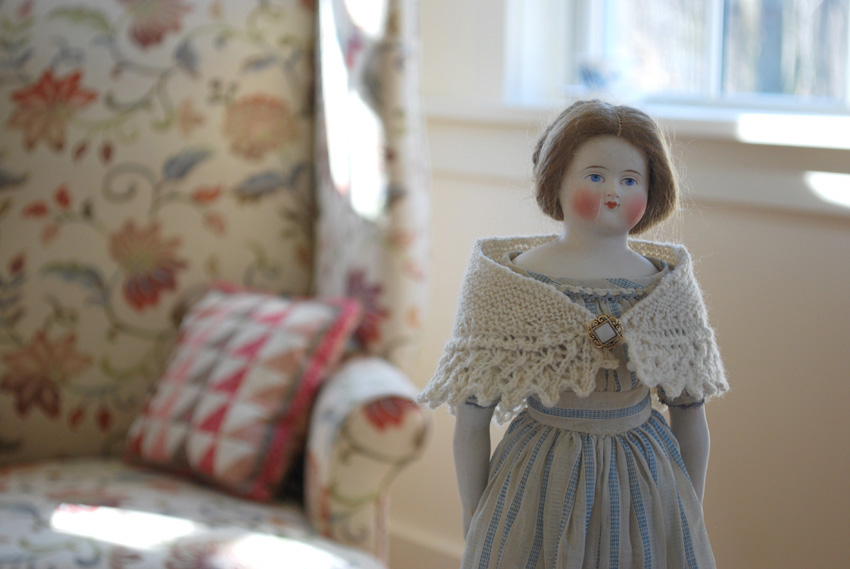
     Helen is wearing her new shawl. I had to put on a thinking-cap (a knitted one of course) while it took me some days to formulate a pattern with size 0 needles. Knitting for Helen is the most frivolous thing I’ve done in a long time. 

     As this china doll was a housewarming gift from my sister-in-law I telephoned her with news of my frivolity. I thought she’d be pleased with the attention I was giving Helen.

antique china doll with knitted shawl

     At first she didn’t like the sound of it. “Don’t dress and redress her,” was my sister-in-law’s authoritative remark. “She’s wearing her original muslin gown, remember? It’s fragile and more than 100 years old.” This came from a serious antique doll collector who knows her stuff, so I took heed.

     “Yes, I’ll be careful,” I said contritely. I won’t handle her too much.” 

     She laughed when her stern warning was over, glad after-all that I was enjoying the company of a fanciful member of the family – even if Helen, regrettably, must be admired mostly from behind glass.  

tiny wool shawl with lace edge
  

Seal Morning
     The craving to knit the shawl came after watching a favorite film (again.)  (My men folk found other things to do that evening.) In an early scene of “Seal Morning” Aunt Miriam is wearing a delicate swallow tale edged lace shawl.

Molly's Lace
I chose "Molly's Lace" from Nicky Epstein's book "Knitting on the Edge." 

     Seal Morning” takes place in the 1930s on a seacoast of England. Rowena is orphaned when her parents die in a car accident. She is sent to live with Aunt Miriam. They meet for the first time – awkwardly. The cottage is tiny. Aunt Miriam’s income is slight. She works at painting china at her kitchen table, while at the same table Rowena works through her lifeless schoolbooks. The cottage is some distance from the nearest town by pony cart, but Miriam is comfortable living independent of friendship and welcomes the isolation. She prefers the company of animals to people.


     The seal pup Rowena rescues brings a bright spot into the dull days of Miriam and Rowena. Although we enjoy seeing the beautiful round-eyed seal I think the story really is about Miriam. She is a plain woman that has some pretty feminine ways about her in spite of how carefully she guards her emotions. Not naturally affectionate she softens up a little and grows in her love for Rowena, eventually confiding in Rowena a piece of her past. A fiancé broke the engagement. Miriam plans never to be so deeply hurt again.

     While walking along the sandy beach and through the lonely marshes, Rowena meets a biologist who is there to study a species of geese. She invites him back to the cottage. The biologist, Bernard, has gentlemanly manners. He and Miriam find that they share common interests. Their love of nature brings their souls together into a quiet (but very guarded) communion.

The family room where we watch films

      I couldn’t help but notice Miriam’s domesticity. With meager means she keeps her primitive cottage neat and tidy. Her hands are busy serving with punctuality and care. Linen conceals the rough table at mealtimes. For tea, little cakes are baked. While balancing a pie on one hand she trims the crust effortlessly with the other. Either the actress had practiced insanely much off-camera to make it appear natural, or pies are second nature to her. 

patchwork pillow cover for Christmas
Christmastime Pillow Cover - I like to make triangles. 

     Will Miriam decide that it is okay to need people? Some women resist giving into the soft side of their feminine natures – especially women today. Although they have remarkable gifts, talents and strengths, rather than lean on a man, they stubbornly rely on their own resources and resist giving into their soft side. None of us, however, is meant to live autonomously.  

The pillow cover is enveloped and tied on the back.

A Little Boy Lost
     Another favorite film of mine is “A Little Boy Lost” with Bing Crosby. If you like hearing his velvet voice singing “White Christmas” this time of year as much as I do, you will also enjoy the few songs in this film. But more so you will be absorbed in the story – that is - once you get passed the flashbacks that take up a good portion of the first scenes. They provide important foreshadowing.

     This is another story about relationships, lingering hurt, and about admitting to oneself, “I need you.” When I feel like a good cry I watch this touching film. It is an instant play on line.

British Evacuees
     Mr. Wainwright is an American radio journalist living in France who meets a French woman, Lisa. They marry. Soon WWII breaks out and Mr. Wainwright becomes a war correspondent. Just after Lisa gives birth Mr. Wainwright is sent on assignment to Dunkirk. Enemy invasion keeps the couple apart. While he works in England Mr. Wainwright learns that Lisa is killed. The baby – now a little boy - is lost in the shuffle - like so many children during wartime.

     Carrying the dull-ache of his sorrow around with him for years, he fools himself that he doesn’t need anyone – not even his true friend, whom he resents for acting as his conscience. Will Mr. Wainwright love, and trust again? Will he find his son when he travels to an orphanage in France or will he give up the search when he meets with discouragement?  


The Story of Holly & Ivy
     The Story of Holly & Ivy by Rumer Godden is a tale that melts my heart at Christmastime. It is a beautiful book and a beautiful story. You may already know I am fond of Barbara Cooney’s nostalgic, folk-art illustrations. Although this children’s story is a bit fanciful to be realistic fiction this is precisely what makes it so endearing for those of us who believe in miracles.


     Ivy is a little orphan girl with a keen imagination and a longing for a doll of her own for Christmas. She also wishes to live in a quaint town in a family of her own. Holly is the doll in the red dress displayed in the shop window wishing for a little girl to play with her (not to be admired behind glass like my Helen). Childless Mrs. Jones, the policeman’s wife, wishes her Christmas gift could be a little girl. Reading how all these wishes come true may bring a tear to your eye. 

“However motherhood [or fatherhood] comes to you, it’s a miracle.” Valerie Harper – adoptive parent


Part of the Family
     Although the book, Part of the Family is meant to be an encouragement to foster and adopted children the book quite unexpectedly brought healing to my heart.


     Some remarkable people in the Bible were separated from their biological families. God used their foster care and adoptive families for His purposes. In these short chapters children will read the story of Moses, Joseph, Samuel, Esther, Daniel, the Israelite maid in Naaman’s household, Jesus (who had a stepfather) and others, in a new light.


      Losses in our lives can make us feel gloomy, forgotten, unimportant, but God can use losses for blessing. Trusting in His sovereignty we can rise above the seeming injustice in this fallen world with trust and gratitude. It is clear to me that author Merle Burkholder (who has cared for foster children) has compassion for young people struggling with this sensitive topic.


A light snow fell the day I decorated the parlor windowsill.

  
      I believe Part of the Family will comfort adults, too, with lingering hurt, adults - though not fostered or adopted - were perhaps raised with an unaffectionate stepparent or absentee parent that they need to forgive - or were brought up in an unbelieving household. All Christians, young and old, can take joy that they’ve been adopted into God’s family.     

“’Well, now, I’d rather have you than a dozen boys, Anne,’ said Mathew patting her hand. ‘Just mind you that – rather than a dozen boys.’”  From Anne of Green Gables
china doll with hand knit shawl


     A few Sundays back, in church service, I curiously found these words in the Prayer of Confession. “Dear Heavenly Father, forgive us for living as orphans . . .”
(Romans 8:16)

     With courage and humility we can say, “I need you.” In loving God, serving, trusting, needing Him - and one another - there resides our source of joy.

     Blessings at Christmastime

   
     Comments are welcome,

     Karen Andreola

Saturday, February 18, 2012

The Well-Fed Mind


The Well-Fed Mind


There is never a time when I appreciate the sun through my windows more than in winter. Special notice is taken of where sunlight enters the house – at what window - at what hour.


Soft morning light enters the picture window over the kitchen sink while I make breakfast. By noon the sun shines directly through the little attic windows of my office/sewing room where I am writing to you now. It filters through the leafless trees and brightens the parlor in late afternoon. As it begins to set lazily, it lends its light to the blown glass at the front door.


Coming down the stairs this light always catches my notice with its strange distorted rays in the front hall. For one fleeting half-hour it illuminates the picture hanging there (which changes at a whim).


This month it is a print by Tasha Tudor. A mother is feeding her children. She wears a smile. We see the quiet joy she has in satisfying the appetites of those she loves. 


In chapter two of her Philosophy of Education Miss Charlotte Mason recognizes that mothers have an understanding of the baby.


“They know that his chief business is to grow and they feed him . . . They give free play to all the wrigglings and stretchings which give power to his feeble muscles. His parents know what he will come to, and feel that here is a new chance for the world. In the meantime, he needs food, sleep and shelter and a great deal of love.” 

Wholesome Nourishment
In her writings Charlotte Mason shows what parents and teachers owe to a child in his later years -  “those years in which he is engaged in self-education, taking his lessons from everything he sees and hears, and strengthening his powers by everything he does.” She repeats herself when she says that, “mind must come into contact with mind through the medium of ideas.”

“Education, like faith, is the evidence of things not seen,” is a curious saying of hers.

Education involves intangibles. Therefore Miss Mason offers an analogy. As the body is meant to grow upon food, which is composed of individual living cells - in like manner the only fit sustenance for the mind is ideas. Like the cells of the body an idea goes through stages of development. We receive an idea with an appetite and some stir of interest. Then, by association, another facet of an idea is added and like my grandson’s snowball, it grows and grows, layer by layer.* The more a child learns the more associations he automatically makes. Teachers who trust in the well-fed mind need not depend on elaborate lesson plans where all subjects are made to correlate in as many ways as possible.   


Mind Set in Motion
Ideas snowball in the mind of a child. They are not stationary, not stagnant. They come to children through various means; through observing nature, appreciating art, and melody; through the rhythmic movement of games, handicrafts, good conversation (not text-messaging), a Sunday sermon, etc. Most importantly they are found in living books. Through books of literary-quality a child gains knowledge mind-to-mind. Miss Mason recommends quality, variety and quantity.

A good remedy for boredom and inattention is a revitalizing presentation of ideas.
Intellectual vitality (something necessary for gaining knowledge “for keeps” – for making knowledge personal) is set in motion when ideas are present.

The Living Book Test
It is safe to say that a living book is authored by someone who takes an enthusiastic interest in his subject. If the book is for children the facts might be related in story form. But they are always clothed in literary language. The test of identifying a living book is like the test of good literature in general. It must be three things. It must bring truth, nobility, and beauty.

It is not dumbed-down but is somewhat intellectual and brings truth.
It is ethical so that we are well-nourished with noble ideas.
It is also artistic and makes its appeal through the emotions.

The Human Touch
Charlotte Mason reminds us that, “children are born persons.” As human beings the style of writing that appeals to them is that which includes the human touch. So we look for books with that touch of originality – books that warm up the imagination. This kind of writing will satisfy a child’s curiosity and foster a love of learning. For all its vivifying features a living book has the right to be called a schoolbook.


Lassie Come Home
One advantage of home teaching (and it is a big advantage) is that the parents are the ones who choose off the world’s menu of ideas. They pick the schoolbooks.            

Eric Knight’s, Lassie Come Home is one example of a book that passes the living book test. If you’d like your child to have an understanding of devotion, courage, hope, brotherly kindness and perseverance this story is a touching example of it. Published in 1940, this is the original story that made Lassie a legend. We made it a read-aloud in our family.

In a certain Yorkshire village there is no finer dog than Lassie. She is a well-trained, well-loved purebred collie – a dog admired by the whole village for her beauty and obedience. When a coalmine closes Joe’s father is out-of-work. Down cast he sells Lassie to put food on the table. Young Joe takes it hard. What makes it harder is that after she is sold to a wealthy duke, Lassie escapes from her kennel three times. Joe and his father must return her.

The duke has Lassie moved to his other estate way up in the north of Scotland so she will never escape again. But Lassie’s instinct is strong – especially her time-sense. It was her habit to meet Joe at exactly four o’clock at the schoolhouse every day. Therefore, near four o’clock when Lassie is restless, she slips through the gate and heads south to Yorkshire - to Joe and his family - with unwavering purpose.


It is a long, long way to Yorkshire. Lassie climbs hills and crosses streams. It is only when she collapses in utter exhaustion and is fed by gentle, caring persons that she stays awhile. With strength regained and a steady determination she sets off again. Parts of the story are somewhat grueling which might make it unsuitable at bedtime for your youngest listeners. It has a happy ending (even if imperfectly so.)


The classic 1943 MGM film starring young Elizabeth Taylor and Roddy McDowell closely follows the book and is the one I recommend. It will introduce you to the characters. This beautiful motion picture is one that brought a tear to my eye.  


*My son-in-law continued to push the snowball until it became enormous - to his son’s amazement. We were standing in the driveway when the clip-clop of a neighbor’s horse and buggy stole our attention. William was mesmerized. I snapped a photograph in the nick of time.


May you leave your visit here today with a little seed of an idea slipped into your pocket.
Karen Andreola  

Wednesday, February 9, 2011

Brightening a Faded Valentine


Brightening a Faded Valentine

As a rule I refrain from pronouncing the word “spring” in January. My lips are sealed. My pen is prohibited. In February, however, I take liberty. Oh, I still keep the winter décor on the windowsill but I allow myself to daydream of spring - because spring is not as far off.


A New Flower to Anticipate
I believe in the elixir of anticipation. Back in autumn I planted some snowdrop bulbs. They are of the earliest spring flowers. Having grown familiar with gardening shortcomings, when planting bulbs I surrounded those of snowdrop with crocus. The crocus are my consolation when snowdrops won’t thrive. Snowdrops bulbs are so tiny and delicate I’ve begun to wonder if they dry-out in shops while on display.


In The Country Diary of an Edwardian Lady Edith Holden features snowdrops as a February flower. The winter I spent in England I couldn’t believe my eyes. When I observed what was taking place in a cement planter just outside the landlord’s French doors I was astonished. Flowers in February? I’ve been charmed by snowdrops ever since. Snowdrops will bloom in America’s northern states but somewhat later. This is fine with me because they would be buried deep in Pennsylvania’s snow otherwise. I am content to wait and anticipate.


A Winter-y Mix
Meanwhile, any-and-all combinations of what meteorologists call, “a winter-y mix” befall us. Roads are hazardous, appointments are rescheduled or “braved.”  Many are the days of gray skies, of wearing the same fuzzy sweater, of making yet another batch of hearty soup. Children have colds. But little ones can be peevish when indoors too much. (William prefers a romp outdoors in the snow.)


In such conditions it may become difficult for the homemaker to conquer and conceal the doldrums. To top it all, would I be singing out of tune if I questioned February as being the best month for feeling as bright and affectionate as a Valentine is expected to feel? Wouldn’t April be better suited?


A Change of Scenery
To rise to the challenge of February I’ve followed the advice of a change of scenery. Yes, a change of scenery can be had within the confines of four winter walls. It lies in a good story. With my shoulders wrapped in a wool shawl, knit primarily for winter reading, I will reach for something adventurous. The Enchanted April by Elizabeth Von Arnim, published in 1923 is on my list of favorites.


I found the film “Enchanted April” so inspiring, so uplifting, so unlike other films, that I sought after the story in print. Amidst last winter’s two blizzards I feasted. Turning a few pages of The Enchanted April at eventide fortified my emotions, piqued my wifely sympathies, and made me a new set of book friends.    


Page one sets the stage. It is February in London during the early 20th century. On a miserable gray, cold and wet afternoon Mrs. Wilkins, running her listless eye down a newspaper column saw this:

To those who appreciate Wisteria and Sunshine. Small mediaeval Italian castle on the shore of the Mediterranean to be let furnished for the month of April. Necessary servants remain.  Z., Box 1000, The Times.   

She was entirely unaware at that moment that her April had been settled for her.

A Beautiful Story and a Beautiful Film
As the story unfolds Mrs. Wilkins and three other very different women (two wives who are faded Valentines) divide the cost of the Italian castle between them and look forward to their own private Ladies Retreat. In their exotic and serene surroundings they relax and are ponderous. The story is beautiful both in setting and sentiments. As the garden blossoms in the bright Italian sunshine so do the hearts of the characters.

A married woman who might be feeling a little faded will be affirmed and encouraged in her desire to be her husband’s bright Valentine.

WIP (work-in-progress) Update
Charlotte Bronte’s sampler is at the framers. I’m working on a pair of mittens with my homespun.


Post Script
The 1992 film stars Miranda Richardson, Josie Lawrence, Polly Walker and Joan Plowright. My DVD is decorated with faux lily-of-the-valley.


The pattern for the garter-stitch blue shawl can be found in my book, A Charlotte Mason Companion of all places. The photograph of the shawl is a candid shot taken on Christmas Day. I reserve the e-bay vintage Laura Ashley corduroy dress for home celebrations.

I was tickled to find hearts with snowdrops (above) in my old clip-art book. On the subject of flowers the Victorians had it covered.

  My Regards,
Karen Andreola