Showing posts with label Cross Stitch Samplers. Show all posts

Monday, February 2, 2015

Free Cross Stitch Chart desgin by Karen Andreola

 Free Cross Stitch Chart

Needlework - the Joy of Accomplishment

What do you do indoors when Jack Frost is nipping at your door? You take advantage of the fireplace.


You keep your hands busy. One grandson asked be be taught how to knit. He has taken to it with gusto. His cat wants to get into the act.


And you read a book that warms the heart.

I asked Sophia (the mother of the above boys) what she remembers to be the most enjoyable book of her childhood. "Caddie Woodlawn," she said. Years ago all my children read it - silently - so I was out-of-the-loop. Recently, I picked it up. Immediately afterward I read its sequel. Now I know why Carol Ryrie Brink's writing is so well-loved and won a Newbery Award. It is so pleasant to read a story where you like the characters and the author obviously does, too. We can guess the source of this mutual affection. Caddie Woodlawn is the author's grandmother. The incidents are based on what Grandma remembered about her girlhood days in the Wisconsin of the 1860s. The stories are true.

Carol Ryrie Brink writes with uplifting humor. Each chapter is a mini story in itself -  is moving, adventurous or sweet - sure to chase away the winter blues - for girls, boys and adults. Christianity and patriotism crop up naturally here and there within the life of this American pioneer family.    

When a little girl, Caddie was sickly. Therefore instead of sitting indoors cutting out quilt squares, Father convinced Mother to let Caddie run wild with her brothers.She gets into all kinds of scrapes. It does make her stronger. But when she reaches age 12 Mother is afraid Caddie will soon be passed learning how to be lady-like altogether. In a bit of a huff Mother says to Father,

"When I was her age, I could make bread and jell and six kinds of cakes, including plum, not to mention all the samplers I had stitched which anyone may see if they care to look in my marriage chest."

Father believes that it will just be a matter-of-time and Caddie will adopt womanly manners. But by chapter 21 some direct words are called for. After Caddie pulls a prank, Father sits down with his daughter in private. He gives her a serious talking-to. But Father is a gentleman. His talk is beautifully stated and worth the price of the book. Caddie receives it well. She trusts her Father. "It is the sisters and wives and mothers . . . who keep the world sweet and beautiful," he tells her. "What a rough world it would be if there were only men and boys in it . . . " A page more of practical and inspiring words round out this gem of a speech on the strengths of womanhood. It brought a tear to my eye.    

Girlhood and Cross Stitch
I wonder if the samplers made by Caddie Woodlawn's mother were kept in the family. Or if Caddie herself ever settled down to stitching one. Samplers were first made for recording alphabets used for marking dainty linens. They were kept in a sewing basket for reference. As the 18th century progressed samplers became picturesque. Elaborate scenes were created below the alphabets.  The needlework was adorned by a border of flowers or strawberries. Watching the BBC 1995 TV Series, "Pride and Prejudice" I noticed, in one scene, patient Jane sitting with needle and thread sewing what looks to be a sampler. How do I know? A tell-tale border of strawberries edges the linen in her hands. 

Needlework in School
During the 18th century the education of daughters of the middle class was most often carried out at home with a mother or governess. Or if money could be spared, at a female academy or finishing school. Women who were unmarried set up a small school in town to earn a living. Sometimes the teachers were widowed ladies needing to provide for any children they might have. Newspaper advertisements from the 18th century exist showing the subjects taught in these schools. English, French, geography, arithmetic, writing, music, drawing, dancing, and needlework. *1

Green dogs? What was Ann thinking?

Within a decade or two after the American Revolution town schools (although with some opposition) were allowing girls. Besides studying their books girls did "regular stints . . . of knitting and sewing." This was plain sewing for the household. But they also did fancy sewing. Each girl made a decorative sampler which was expected to be a household treasure ever after.*2 Proud parents would frame the sampler and place it on the wall of the parlor.

Charlotte Mason Recommends Samplers
By the late 19th century, sampler-making was becoming less popular. Curriculum was changing. But it was given a mention by Charlotte Mason. Among the useful handicrafts, knitting and rug-hooking, etc. she recommends "samplers on coarse canvas showing a variety of stitches."*3 Today girls might start with Aida cloth.


My newest project is "Anne Anthony - 1786" - (below). The original is in the Museum of Fine Arts, Boston. All I can show you is my slow but steady progress at the top. It is a challenge in size and detail. The strange threads you see along the top, etc. are my way of marking off the tens. Among the alphabets, birds, and flowers, there is (not shown here) a blue house to be stitched soon and what appears to be a large family dressed in period clothing. The little girl holding the hand of a big sister might be Ann herself. Here's a good tip for stitching large areas. Count alertly. Outline accurately. Then fill in comfortably.

Moral Verse
Quite often a moral verse was stitched into a sampler. Stitching helped to hide virtues in the heart. Needlework was not only a skill but a reminder of Christian humility, reference, and good works. What I am showing of the antique blueberry-raspberry sampler - 1847 - (with the green dogs), are from a reproduction that I finished - by a different Ann. I changed the verse to one that is more meaningful to me than the one charted - "The Old Rugged Cross" (above)

Ann Anthony - 1786 stitched lavender strawberry buds in her border. The bird is waiting for lavender silk thread.

Here is a verse stitched into the antique sampler of Martha Perry in 1800.

Are not the sparrows fed by thee,
And wilt though clothe the lilies and not me.
Begone distrust! I shall have clothes and bread,
While lilies flourish and birds are fed.*4

I'm taking my time with "Anne Anthony - 1786." I'm in no rush. I mustn't be. That isn't the way a sampler is created. For Ann it went slowly, too. It took a year to complete most likely. She worked on it dutifully, probably before she would be allowed to play. But the hours she worked on it couldn't have been all grim. The months it took to complete produced the satisfaction of work well done - the joy of accomplishment that is earned by self-discipline.

Free Cross Stitch Chart

A Mini Cross Stitch
Free Cross Stitch Chart I like small projects, too and in hopes of encouraging beginners I designed one for my blog friends and their daughters - "A Bleeding Heart Spring."


Free Chart

Click to download: 
A Bleeding Heart Spring.pdf
I include instructions (scroll below) for beginners.


One of my first - Aida cloth - with glass beads
End Notes

*1. Rebecca Scott, Samplers, Shire Pubs. pgs 43, 44, 45. (I enjoyed reading this well-written history of needlwork in England.)
*2. Clifton Johnson, Old Time Schools and Schoolbooks, pgs 141,142
*3. Charlotte Mason, Home Education, pg 315. (Her word "sampler" popped out at me as you may imagine.)
*4. Patricia Ryan & Allen D. Bragdon, Historic Samplers, Little Brown, pg 160
Caddie Woodlawn was written in 1935. (for grade 5 - up). After receiving so many letters from children urging her to write another book about Caddie, Carol Ryrie Brink finally did - ten years hence - Caddie Woodlawn's Family - formally Magical Melons


Happy Stitching,
Karen Andreola

Stitching in the sunny parlor.

Instructions
Four holes on Aida cloth will accommodate one cross. No hoop is needed if stitched gently while snugly. DMC floss has 6 strands. Separate the strands to use two in a size 24 tapestry needle.
Start with a 5-inch square (at least or larger) of 14-ct Aida. I used linen. My picture is less than 4 inches square. You can start with the flower a couples inches from the top of your cloth. Outline and fill-in. I started with the rabbits while I worked out the design. Use any color floss you like or those I listed on the chart.

Pincushion
Trace a 4-inch square around your finished picture. Sew a quarter-inch seam, leaving an opening for stuffing. Under my linen I used a fabric interfacing but Aida will not need this. Choose calico for the bottom. Stuff pincushion densely. Lace at the seam is optional. One of the Christmas gifts I received was tied in bright red chenille rick-rack. Wanting to use this darling stuff up is what gave me the idea to make my pincushion and up-the-brightness of the thread color of the bleeding heart to match it.    


Monday, November 17, 2014

A Screen-free Quiet Time

A Screen-free Quiet Time
 I’ve come to the end of my Sunday school series: “There’s No Place Like Home”. I enjoyed teaching it and would like to continue come spring. I especially appreciated how the older moms in the class shared hints and experiences with the younger moms. 
 
In the last class I talked about the importance of fitting into the rhythm of the day, a screen-free quiet time. One mother in the class is a home educator. Another mom plans to home educate. Therefore, I kept my topics general to be edifying to all. But you must know. I can’t help my bias. My secret opinion (which is no secret now) is that it is the home teacher - who works diligently with her children all day – and who by no surprise runs out of steam - who could glean most gratifyingly from my recommendation.


To the home teacher solitude is golden.
Part of home teaching is learning and living abundantly and joyously alongside our children. A mother can do many things with her children about her. But there is also a private aspect to the religious and creative life that thrives in moments of solitude.  

This November I’ve had a quantity of quiet time. I’ve stayed close to home. Puttering about the house I’ve been patiently trying to wean off a medicine I started for chronic pain. Anyway, by contrast, how vividly I remember those early days of motherhood.  By an orderly arrangement of hours I squeezed in a little quiet time - for myself and my children. It was good for all of us. A break is good for body and soul. Being alone gives refreshment to togetherness. It seems to be something necessary for creativity and reflection.  


"Shakespeare, Leonardo Da Vinci, Benjamin Franklin and Abraham Lincoln never saw a movie, heard a radio or looked at television. They had loneliness and knew what to do with it. They were not afraid of being lonely because they knew that was when the creative mood in them would work.”  Carl Sandburg (poet)

What is my recommendation? Pick a time in the day that works for you. Be faithful to it. After some weeks it will feel quite normal.

I remember following a string of morning of lessons with a late lunch, chores, and a picture book read aloud to settle the youngest child (above the age of napping). Then, with every child in his or her quiet time spot - set up with a screen-free occupation of their choosing - I’d turn the dial on the portable kitchen timer to set it to ten minutes (graduating to 20 minutes thereabouts). I’d place the timer in the upstairs landing outside the bedrooms. And I’d retreat. 


Leaving the timer to its ticking I would sit in a sunny window overlooking the back garden. I’d bow my head to read, pray, journal, write a paper letter, or just lay flat on the bed for a stretch and watch the dust in a sunray float in the air and settle on the nightstand. If I could forget about dusting for the time being, I’d feel my shoulders relax, my forehead soften, and my eyes want to close. 

When the timer reached the rickety ringing of its real bell, the children knew quiet time was over. We would return to the active parts of our day with renewed vigor – and perhaps even a renewed attitude.   


Later in the afternoon, padded by thick sweaters we would file out the back door. We needed the fresh air and the removal of four walls. The children would head for rope swing, bicycle, or wagon. Or, we would take an autumn nature walk together shuffling through the fallen leaves. 

A wise mother will, if possible, proved opportunities for her children to be alone so that each one will learn how to fall back upon himself for counsel and entertainment. Beautiful Girlhood, chapter 23 “The Quiet Hour” 

Explanation of Photographs


This month, on a yellow-leaf day, I assembled the pattern pieces I cut out for an apron for myself. I will continue its progress when my Christmas presents are completed. I decided to lengthen the hem and omit the ruffle. I will cut out a plain square pocket to applique the pineapple I cross-stitched. A pineapple can usually be found somewhere in the kitchen.

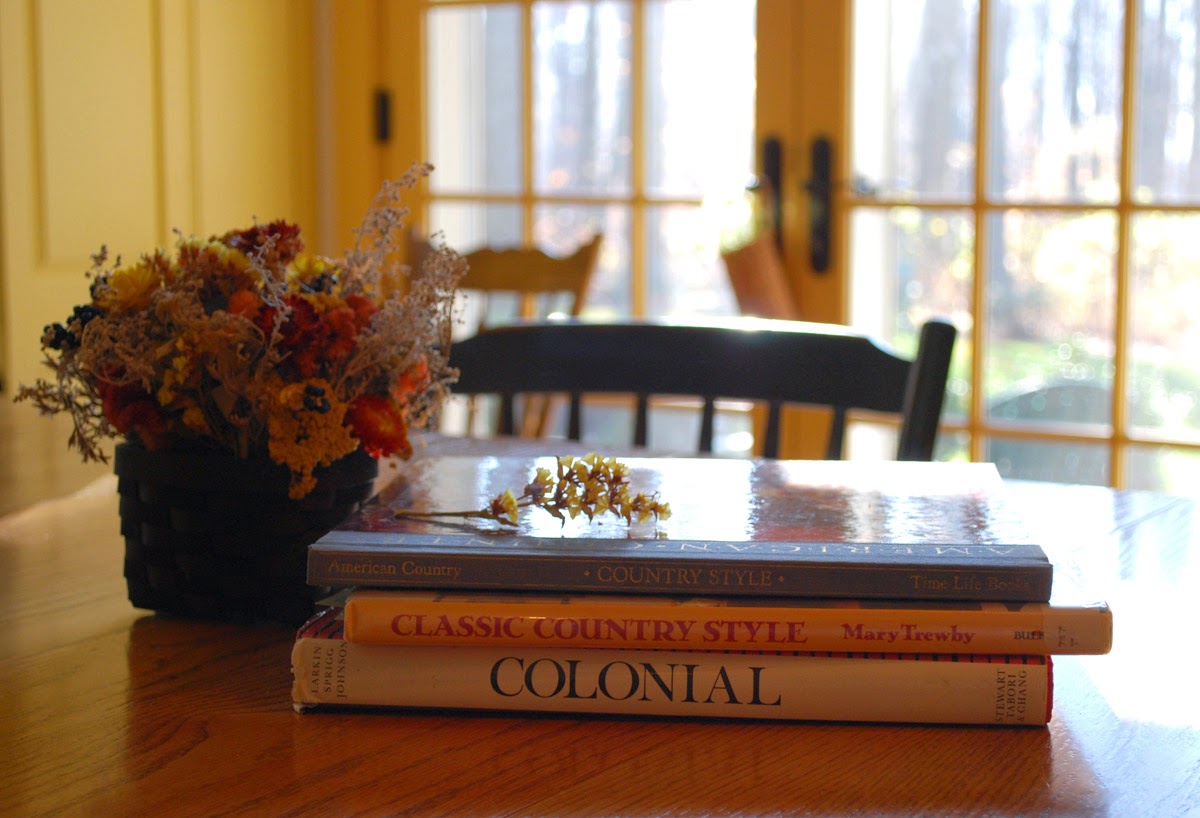
Second-guessing the green paint color I chose for the parlor I took some decorating books off the bookshelf. I guess you could say that I am “in between” computers since my old computer no longer supports Pinterest. Therefore, I am glad I kept several decorating books on hand for these bouts of indecision.


Several years ago I stitched this strutting roaster (or is it a turkey?). Anyway, I liked its message and am passing it on to one of my married daughters. It could be displayed for a variety of holidays. 

The nesting dolls are waiting for my grandchildren on Thanksgiving Day.  


In a quiet time I opened Drawn From New England – a biography of the children’s book illustrator, Tasha Tudor, written by her daughter Bethany in 1979. Lost for some years my copy was recently found in my daughter’s house. I was glad to see it again. Today I do not have the same startling enchantment I once had of it. In the mid-nineties I was still in the throes of nest-building and wrote a review of it for an issue of Parents’ Review. Oh, my. That was nearly 20 years ago. And yet, although my interest is subdued I can still appreciate Bethany Tudor’s affectionate writing. 


She marveled at how her mother turned every household chore into a domestic 19th century art. This must have been quite a feat in the years just after WW II when the young family moved into a 17-room ancient New Hampshire farmhouse without electricity, modern appliances, indoor plumbing and central heating. The hours of Tasha Tudor’s day were spent waking up early to milk a cow, attending to her garden, baking bread in a black-bellied wood stove, washing buckets of clothes by hand and sewing much of their own clothing. 


For her four children and herself she balanced manual labor with make-believe. And Tasha Tudor made much of birthdays and holidays with creative homemade efforts. The family’s lifestyle and fanciful seasonal celebrations became a model for the water-color illustrations in the children’s books for which she is best known. Some of the most vivid memories Bethany Tudor has of her mother are related to her art. Practically speaking, book royalties paid the bills. 


Tasha Tudor created a beautiful old-fashioned life for herself and her family. The Christian mother will create her own culture of family traditions while remembering to live in the reality of the Kingdom of God.  

Is a quiet time retreat in your schedule?


Comments are welcome,

Karen Andreola


Monday, June 23, 2014

Sunshine and Shadow


Sunshine and Shadow

     Are you new here? Welcome. Feel free to click about. An array of articles awaits you. I hope you glean something helpful from them. Today, rather than an article, I share a piece of my present life. For my long-standing readers I offer an apology for not reporting the results of my medical treatment sooner. Thank you most sincerely for your prayers and kind notes. Perhaps the reason for my delay is that I have resisted coming face to face with the truth in print. The extended weeks of treatments for neuropathy and Complex Regional Pain Syndrome were unsuccessful.


     Some of you know that I started this blog in 2010 partly as a diversion from chronic pain. It’s been a pleasure to connect with people. Since writing the story, Lessons at Blackberry Inn, writing articles has enabled me to minister with an outward focus. This blog is a place where I can be hospitable with ideas. I hope I have made it a pleasant and ponderous place for you to visit. 

     I’ve been away from blogging for a bit. First, Sonja Schafer honored me by interviewing me on her insightful blog. Then, I spent the week at my eldest daughter’s house. Sophia’s family lives two hours from us. The photos are mostly from her camera. I was given the room over the garage. The futon was perfectly comfortable with the thick mattress topper Dean insisted I bring along.


       At 5:30 a.m. the sun was rising. Oh, the birds. Their notes revealed their numbers although they were invisible. Such carefree carols made my heart sing along. This was my unquiet quiet time before the two little boys were up and about feeding their pets. Each morning I would sit perched on the edge of the futon with a pen and spiral notebook open, reading and jotting down thoughts in the morning light. I intentionally left my laptop (and all electronics) at home. The view out my window was surreal: acres of Christmas trees. 


     The change of scenery was appreciated. But I came primarily to play with my grandsons. On one of the rainy days, for it was a rainy week, the 3 year-old was a cowboy. He wildly rode his stick horse chasing his brother from room to room. This same little boy had had stitches in his forehead twice the week prior. What enormous energy little boys have when they play together. I put myself to bed ten minutes after reading their bedtime stories.


     I was seeing the house for the first time. As a sort of hand-me-down, house warming gift, I passed along my (wool fabric) braided rug. Sophia says it adds warmth to the fireplace room. On another rainy day the 6-year-old set up a long wooden railroad track on the rug. When the sun managed to poke through the cracks in the clouds I watched him in the sandbox and on the tree house slide in the back yard. Sand is one of the best of toys.


     My daughter has fond memories of her storybooks. She finds pictures on-line, prints them out, and places them in frames. It is a frugal way to decorate, she says. This one, by Eliose Wilkin, stood beside me near the futon. 


     For the wall above her computer Sophia printed out botanical flowers she searched for on-line. Using dime store frames, she gave each a thin coat of paint, then scrubbed to reveal a bit of wood grain.


     Above the pie safe, that stores home school materials, is a broken clock. It was stitched by her mother-in-law who passed away during the school year. It doesn’t matter that the hands of the clock are missing and that it cannot keep time. It was made by someone special whom Sophia loved and misses and that is what matters most to her. This is how I can tell she values it. See how the dainty live basil trees accent the clock on either side? (Click any image to enlarge.)


     Sometimes sorrowful or scary circumstances surround us - or just plain exhausting ones. For the struggling Christian it may seem that joy is at the bottom of a well. It is never obtrusive, but there it waits, cool and clear, promising to refresh. We have to practice our faith, to send down the bucket on a reliable rope of faith . . . and draw up joy hand-over-hand. As I sat alone in the guest room with my supplications, staring out over the acres of Christmas trees, I tried not to be overly sorrowful about the life of limitations my son has to accept as a newly handicapped person, just on the brink of his career. I tried to be patient about my husband’s job hunting, and not anxious that my pain has been steadily increasing in spite of invasive medical treatments and all my veggie juicing.
     There are myriads of things out of our control. Circumstances were out of the apostle Paul’s control. He was knocked down and near death, but always got back up. I think he was lifted up. He learned through his trouble that a joyful heart is “anxious for nothing” and urges us to do likewise. I have a Heavenly Father who is in control. And how wonderful (what manner of love is this?) to be called one of His children.
 (1 John 3:1, 2)


     A far-away friend admonished me by letter when I reported our woes. “Karen, count your blessings like you count the stitches in your beautiful samplers,” she wrote. I was touched by her words put in the imperative, because they were not shared indelicately. (Phil 4:8)

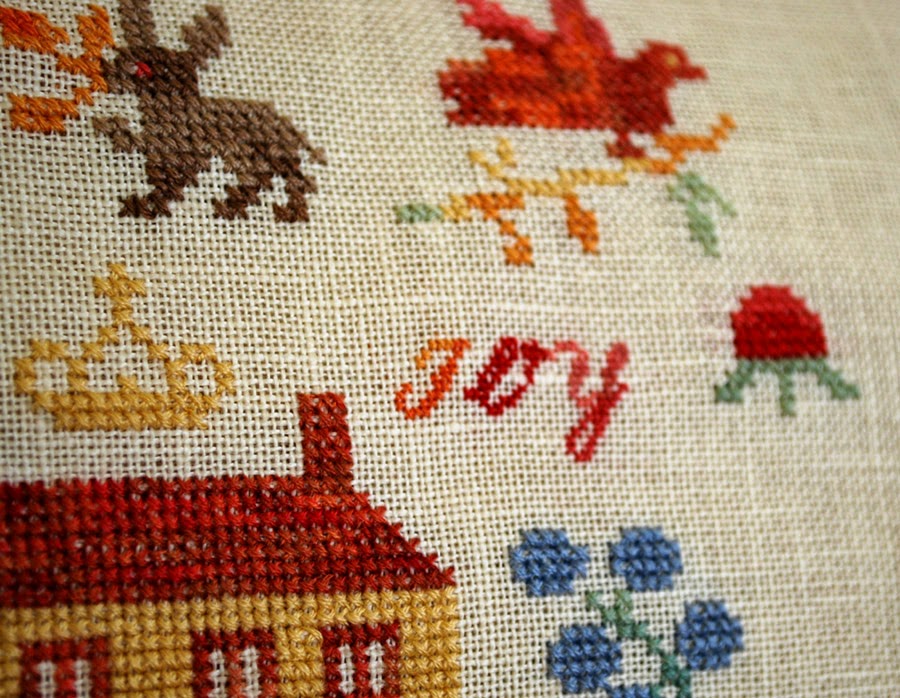
     Speaking of samplers, I finished the one I had designed for Sophia and presented it to her. Do you remember she requested a house sampler months back? To make the top half I followed a chart of a girlhood sampler of the 19th century. Then I fit together spots from several samplers for the bottom half. “E” is the family initial. The trees are the Christmas trees adjoining their property. The sprig of blueberries is reminiscent of Maine.

     The single strawberry is just-because she loves strawberries, which ripen during the month of her birthday.


    At last, I chose the word “Joy” in teeny tiny one-over-one stitches. It is such a little word but its deep gratitude makes a “cup runneth over.”


     Sophia is the only female in her household and I in mine, so we treated ourselves with girl-talk. Later, on the front porch, when the sun was lowering in the sky, the breeze blew through the silver wind chimes. I commented on how clear and pretty the chimes sounded. “That’s because this one,” she pointed out, “chimes the first notes of Amazing Grace.”
     “Really?” I said brightly then listened some more. The beautiful chimes created a lull in our conversation, which few things can do once girl-talk gets on a roll.


Thank you for your visit,
Karen Andreola


More News
     Here is a link for Sonja Schafer’s blog interview. At the end of the interview you will see that Simply Charlotte Mason decided to sell all my books. Neat. Perhaps there is a description of one that sounds like it would uplift your life. If so, I hope you will consider purchasing it on their website. If you like your visits here you will feel very at home on the pages of my books.

     During my week away I used my daughter’s computer to read my emails one evening. What a surprise. The mice at Linnie’s Butt’ry and Book’ry chose my name for the prize of a handsome gardening book. Fun.      

Saturday, July 20, 2013

Welcome Indoors


  Welcome Indoors

Colonial yellow fireplace surround  
   The weather is hot. The Lady-of-the-House has been indoors. Phew, how thankful she is for air-conditioning. Other years she’d been without it. Then, all the cooking for the day was done immediately following breakfast. 

     All week the Lady-of-the-House has had her nose in books and her fingers to the keys. That writing will be shared later. Today she invites you to take a leisure stroll with her in the cool of indoors – or should she say scroll? 


     In springtime the Man-of-the-House bought his wife a faux rose bouquet. She had her eye on it when they walked through the tourist shops of Lancaster on their wedding anniversary.

     When she returned home she placed the flowers on the fireplace mantel. The Man-of-the-House also bought her a pineapple, a real pineapple. He is good at slicing it into pieces with a menacing-looking kitchen knife. He does this often for her even though he himself is allergic to this delicious fruit.


     Coming down the stairs in the mornings the Lady-of-the-House can snatch a peek at the historic sampler of Sarah Tobias. The original was probably stitched in red. The cover of the cross-stitch book by Blackbird Designs shows the original antique. It suffered years of light damage and so is a very faded pink and tan in its present condition.


Colonial blue stairway


     With the staircase painted blue the Lady-of-the-House decided to stitch the sampler in three shades of blue, brown and white Gentle Arts Threads. She enjoyed improvising the colors of the funny little “spots.”

Sarah Tobias sampler in blue


     She must have been drawn to stitching this sampler because Sarah lived in Pennsylvania, a neighboring county, as a matter-of-fact. That was nearly two hundred years ago.


     The Lady-of-the-House added her own inscription to tell that it was “respectfully reproduced in 2009.” Later, in a local antique store she spied some old bed linen with a few of the same decorative spots all in red.


     In the front hall, at the bottom of the stairs, is a picture that was given to the Lady-of-the-House. She was forward enough to drop a hint for it – out of character. It hung in her daughter’s house.

Colonial blue entrance hall and split staircase

     “That picture is darling,” she told her daughter when she was visiting.
     “It’s my most recent find at the corner charity shop,” her daughter said proudly. “Can you guess what I paid for it?”
     “I can’t think,” her mother said.
     “Two dollars.”
     “Really?”
     “Yes, really.”
     “Hmm, it would look good in my house,” her mother mused.
     “Take it.”
     “Honestly?” her mother said brightly.
     “Yes, take it.”
     Giving-in halfway her mother said, “Okay, I’ll borrow it.” It’s been borrowed two years. But it must be known that the walls of her daughter’s house are adorned with pictures that were once hung on her mother’s walls.


     Cutting fabric for piecing was done here and there over the winter. Squares were cut into triangles. Triangles were made into pinwheels. Pinwheels were sewed together to make a pillow. It became a birthday present for her daughter.


Folded star pincushion in Colonial reds


Antique pie safe


     “I have enough fabric to make another one just like it.” This idea occurred to the Lady-of-the-House when she wanted to see what the finished pillow looked like on a chair, before it was slipped into a gift bag. It matches the country style and colors of the family room, she noticed.

     But alas, she got swept up into other projects.

(You can see the "Charlotte Mason" sampler framed over the pie safe.) 


pin wheel pillow piecing


     For another married daughter’s birthday the Lady-of-the-House made Madelines.

Madelines homebaked


     Madelines are a buttery finger-food dainty enough for a tea party. They can be served with fresh berries or a spoonful of berry preserves (not shown). The painted border of blackberries on the birthday girl’s Brambly Hedge plate had to suffice for that afternoon.

Madelines on Brambly Hedge plate


 Come Again,

Karen Andreola 

Saturday, May 25, 2013

Willing Hands (of Louisa May Alcott)


Willing Hands
(Of Louisa May Alcott)
      
     Two years ago I purchased a sampler chart made in Denmark. The original sampler stitched by Anna Thies in 1859, once hung in the Deutschen Stickmuster Celle, a museum in Germany. The museum closed this year.


     The DMC threads and linen were acquired at Hodge Podge in Historic Strasburg. I like the sampler’s fancy alphabet, the cat, the faded wreath of roses – representing the aged appearance of the sampler today - faded that is – all except for its tenacious Turkey red.


     Little by little I worked on it.

     Ideas occur to a stitcher. In the relaxing slowness she ponders. It occurred to me after stitching the first alphabet that I might replace the second with a verse from Proverbs that especially speaks me.


She seeks wool and flax, And willingly works with her hands.

     How convenient it was that the thread count within the space accommodated the verse nicely.

     While I began to stitch this into the sampler I had my head in the biography, Invincible Louisa, written by Cornelia Meigs in the 1930s. Its pages contributed to my Mother Culture. Here’s why.

     It is encouraging to get to know a woman such as Louisa May Alcott – a woman with “family love, loyalty and devotion. Upon such things the very structure of life is built.”*1 She worked with willing hands for the extent of her life.

     I liked reading the earliest parts of the book, Louisa’s infant years when her father, Bronson Alcott, was a contented teacher for a Quaker community in Pennsylvania. In a few years circumstances become strained. The Alcott’s experience pangs of poverty and dismay – but accompanied by courage and good humor – remarkably so.


     Bronson's experiment at Fruitlands in Massachusetts is his attempt to live out the utopian ideals of Transcendentalism.  His wife Abba – the only woman of the little commune - has her hands full. She “who had toiled without ceasing for a moment since daylight, would be sitting by the single lamp, sewing as though her life depended on it.”*2 Abba prepares all the food, sweeps, washes, and keeps their family of six clothed quite primitively. Unlike Louisa’s novel Little Women, there is no mention of an “old Hannah” to help out.


     The tree-lined meadows of Fruitlands were a beautiful expansive playground for young Louisa - one of four sisters - but her memories of it were not always bright. At age 8, she admires her mother’s spirit and helps her in any way she can, for there were times when Abba is left to take care of the farm.

Pretty lace maiden made by a mom in Australia


     By contrast to the Shaker Community across the river, which traded with the outside world, Fruitlands was meant to be self-supporting. Yet, it is doomed for other reasons, too. No animal could be forced into labor to plow or harvest. Nothing an animal produced could be used for food. The men of the commune are more philosophic than practical. In seven months the experiment ended. 


     Invincible Louisa began to wear on me as any tale of struggle would. The countless household moves and the inability of Bronson Alcott to provide for his family aroused my sympathy. He has no talent for commerce. His teaching positions are fleeting. A profound thinker and excellent speaker he travels and lectures on transcendental philosophy. The pay is a pittance but Abba always welcomes him home with open arms. 

cat in cross stitch

     I am glad I kept turning the pages. Although difficulties arise in dwelling after dwelling where they live, there is never depression. “Something ridiculous was always to be seen in every adventure, something to call forth mirth and become the basis for a family joke.” *3 Doesn’t this sound like the stories she wrote?

     As a young woman Louisa sets out to somehow be a financial help to her family. She writes for magazines. She authors little fairy stories. This is something. But when finances become desperate she learns that her long hair is worth a startling and tempting amount of money. Does she ever cash in this reserved capital?

cross stitch sampler
Ready to stitch the butterfly in the late afternoon sun


     After serving her country, nursing wounded civil war soldiers in Washington D.C., after utter exhaustion, recovering from a life-threatening illness, Louisa is urged to write a novel by a renowned publishing agent. She sees the need for a story of quality, “instead of the sentimental and tragic tales which [young] minds were usually fed.”*4 Little Women is the result. It was an instant success, a book well loved by many.


     Cornelia Meigs softly relates that Louisa “was unlike Bronson, that although she was devoted to him, there were certain of his ideas which she did not truly comprehend, . . . she did not quite fathom the motives behind them.”*5 In Little Women in which she writes about what she knows and loves best  - her mother and sisters - she says little about the father of the story. She does, however, acknowledge Bronson while she describes the perfect school for poor boys that he always dreamed he could establish.   

     With the publication of Little Women, and her other novels, Jo’s Boys, Little Men, An Old Fashioned Girl, Eight Cousins, etc., that follow, life gives Louisa what she asked of it - finally - security for those whom she loved dearly – a happy ending. Fame and fortune are won by some but few win it with so much affection, affection that lasts for more than a century.


     Although Louisa May Alcott’s novels will appear as suggested reading for young readers, and this is fine, I think a more mature student would benefit by her greater sympathy.

          One of her fairy stories is among those in Faerie Gold. I haven’t read it but it interests me. 

     In Your Story Hour Volume 2 a commemorative tale is told about her. The Your Story Hour recordings were heard over and over in our family. They will meet the expectations of those who seek inspiring content expertly told.

     After a novel or two, a high school student would appreciate Invincible Louisa. Above all, this biography as well as the novels, makes a welcome read for an adult. By them we who are walking through life’s pressing responsibilities, we who are faced with life’s increased challenges, will be reminded not to give up on our dreams.   


End Notes
Cornelia Meigs, Invincible Louisa, Scholastic Inc.
*1 pg64   *2 pg 56   *3 pg 89   *4 pg 200  *5 pg 213

    
     Do you like historical houses? I do. To see a tour of rooms click Orchard House. It is where Louisa wrote Little Women. Fruitlands is preserved and open as a museum today, too.

 
Anna Thies reproduction sampler
My sampler photographed on the back of the sofa awaits framing.  Can you see the verse from Proverbs?


Comments are Welcome,
Karen Andreola