Thursday, September 1, 2011

A Cleansing Breath for Mother Culture


A Cleansing Breath for Mother Culture

Those who have undergone physical therapy know that between exercises it is advisable to take a deep “cleansing breath.” Remembering to stop to take a cleansing breath among complex responsibilities is a principle I’ve carried over into Mother Culture - both literally and figuratively.

Several weeks ago our 1997 American-made car was equipped with a new transmission. “They don’t make cars like this anymore,” I was told. I believe it. I am a trusting wife - generally. Feeling something like what the owners of a new car must feel, Dean and I filled the trunk with provisions. It held a weighty ice chest of local produce, homemade raison cookies, farm eggs, the big camera, two suitcases of holiday clothes, suntan lotion, straw hats, sundry books and (I didn’t forget) yarn. With the packing complete we set off on a few days vacation on the Jersey shore. My parents live in a bungalow a block from the ocean.

Dean and I do not travel lightly. In the heat of the glaring sun we (Dean mostly) walked back and forth unpacking the trunk, armload after armload. Mom and Dad’s neat little bungalow was quickly transformed into a house of stuff. Normally, during our short visits I try to conceal our stuff in assorted baskets. Alas, it still looks out-of-place.

Glad to see us Mom and Dad graciously overlooked our clutter - as always. Then we settled down to a good long chat. A sea breeze drifted through the windows cooling our brows as we unraveled the details of our lives. We tossed in all the family news we could think of for good measure.


In the mornings I put on a vintage (sounds nicer than outdated) Laura Ashley dress for a quiet walk at low tide. Here I took a cleansing breath – a whole series of slow deep breaths this time  – of salty sea air. It was windy yet invigorating. 

A flowery dress at the seashore fulfills a romantic notion of mine. 

The yellow dress with the coral flowers and the shawl collar has a string of memories attached to it because it was purchased twenty years ago. A first violin recital, a home school graduation and a speaking engagement are a few memories that stand out. 


The mostly orange dress here and at the start of the post is one Dean bid for me on e-bay last year. The cost was quite reasonable. I’ve only started making memories in this one.

We walk up the beach in silence, but in harmony, as the sandpipers ahead of us move like a corps of ballet dancers keeping time to some interior rhythm inaudible to us. . . Emotions are carried out to sea. (From Anne Morrow Lindbergh’s Gift From the Sea chap. 6, page 101 in my grandmother’s copy handed down to me.) 


From my beach bag I placed a child’s cotton sweater at the edge of the dune grass. It’s a pleasure sharing my knitting with you. 


Dean, who uses his camera more intelligently than I, and wanted to protect the lens from windblown sand, took the photographs for me. It was nice to have his help - although I’ve learned to save knitting as a subject of conversation for those more readily inclined.


The variegated blues and wavy wool cables of this size-two cardigan make it at home at the seashore. I had fun knitting it from a pattern by Yankee Designs. Can you see the little wishbone cables one stitch in width? They remind me of horseshoe crabs in this setting. Seed stitch and blackberry stitch are placed between the fisherman ropes. 


While braver souls - at least half our age - were going in deeper, we faced the breaking surf our own way. We were jostled by the foamy undertow. How refreshing the water was – even if somewhat wearing. Returning to our umbrella the cameraman was smiling. He was satisfied that, yes, his wife now drenched in seawater, was indeed having a good time.

Next came the relaxing moment I had been anticipating. I took out of my beach bag the beginnings of another little sweater. Its stitches were cast on at home, a week prior with the hope of spending an hour of knitting bliss in the shade of a beach umbrella - the ocean before me. Involuntarily, I sighed after my second row. Then I remembered. I closed my eyes and took a slow cleansing breath. Gratitude inhabited the pause.


For body and soul, in your everyday, will you remember to literally take a cleansing breath now and again? Also for your Mother Culture I hope you will consider taking one figuratively - in whatever way you come up with. No doubt it is fast becoming a busy school year. 

Post Script

After a bath Baby is happy when wrapped in the green blanket Mommy knit for him. 
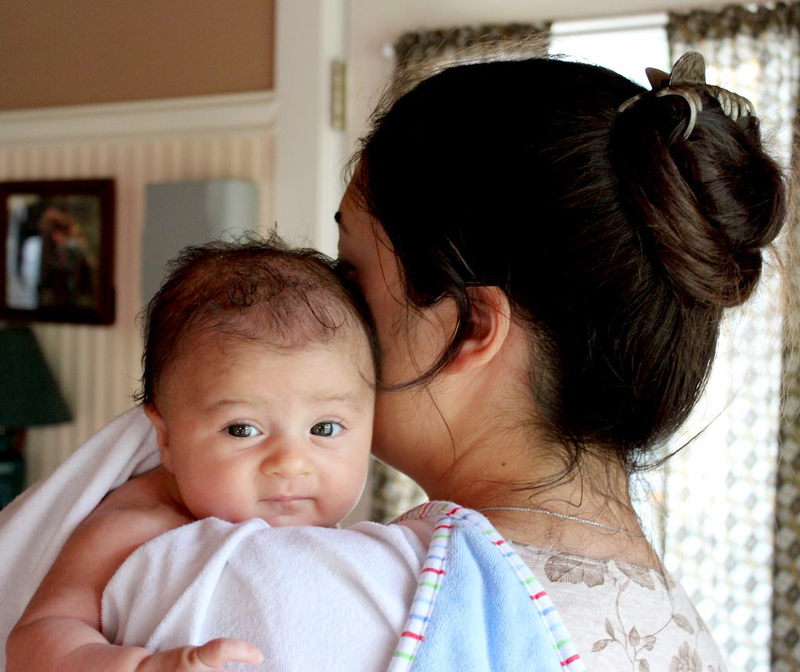

She only knits when expecting. That’s okay. Another knitter is keeping an eye on domestic supply-and-demand.


Blessings to you
Not for knitters only,

Karen Andreola

Friday, August 19, 2011

Ripe Tomatoes

Ripe Tomatoes

A person can show his religion as much in measuring onions as he can in singing Glory Hallelujah. 
A Shaker


A walk to the end of her street provides a view of an Amish neighbor’s farm. The Lady of-the-House likes to view the progress of their large gardens. They are a big family - generations living together - and use their land (with big horses) in a big way. Agriculture is their livelihood. The Lady-of-the-House keeps a couple organic tomato plants, a few zucchini, a handful of bell peppers and an assortment of herbs in and around the flowers. She is rewarded with the gift of growing things – even if in a small way.  


Chapter Two of Lessons at Blackberry Inn begins with:

Emma’s garden was overflowing with a bumper crop of tomatoes. Ripe tomatoes of all sizes filled every spare bowl, bucket, and nook of the kitchen. We skinned, boiled, and strained these “love apples,” as they were once called, for most of the morning. Perspiration beaded on our faces as the heat in the kitchen rose. The windows let in too little breeze to cool our brows.

The Lady-of-the-House admires the frugal canning activity of a friend - especially when she receives a jar as a gift. Her friend preserves nature’s bounty like her storybook characters. All summer as each fruit (Is the tomato a fruit?) meets its time of ripeness, she puts a carefully chosen recipe to work, turning it into sparkling bottles of delicious preserves for her family.

In this photograph, taken last month by the Man-of-the-House, one enterprising mother’s bottles are for sale.


Like her character Carol, the Lady-of-the House is fabulously fond a ripe tomato. Can you tell?

Next [Emma] sliced some bread and the biggest reddest tomatoes that had been set aside for our tomato sandwiches. One thick slice made a perfect sandwich. Piling the hot corn, buttered and salted, and the sandwiches on plates, we joined the children outside to eat.

“Nothing is redder than a ripe tomato,” I said after a juicy swallow.

“I think the tomato sandwich is my favorite,” said Emma. 


In August tomatoes big and small hold a place of beauty and taste for the Lady-of-the-House. These three ripe, organic, crimson beauties were purchased at a farm stand. They are grown in a large greenhouse that seems an acre in length.

This summer she only grows grape tomatoes. Two plants are providing an on going supply.

Grape tomatoes are just the right size for snacking on like grapes, cutting in half to add to an olive-and-basil pasta salad, or for dotting a broccoli quiche.

Sometimes the Lady-of-the-House will make a tidy breakfast quiche or two a day ahead when overnight company is anticipated (like today).


When newly married, she used to dream of her ideal herb garden - an expansive Colonial garden divided by a pebbled footpath, housed inside a quaint picket fence, with a gate that closed on its own by a weighted chord – in historical style. Out her kitchen door are a few fragrant herbs – not a museum garden. But she is satisfied.


Like the thyme some are in pots.


Like the oregano some are tucked in among the flowers.


She is happy - although the broken pot of sweet basil is too shabby to be chic.


Do you see the china teacup among the tall daisies? It is secured on a copper pipe. When this whimsical ornament fills with rainwater thirsty flying creatures visit it. It seems to have the added benefit of being an unsuspecting Japanese beetle trap. (More beetles – not pictured- met their demise inside the cup).

She bought her garden cup at Main Street Manor B & B in Flemington, New Jersey. Donna’s father makes them. Donna more charitably keeps birdseed in hers.

The garden teacup is a little touch but it makes a difference to the Lady-of-the-House. When she spies it through her front window or passes it when walking to the mailbox she is reminded to “sit for a bit.”


Sometimes she feels silly when she compares big things to her little things. Then she remembers that little things have a place, too, because they can make a big difference.  

Importantly, little kindnesses, little gestures, little courtesies, tact and attentiveness, in relationships, make a big difference in the atmosphere of home. We cannot know which big things - or which of the myriad of little things we mothers do - will have the most meaningful or lasting affect. Never mind. Day-by-day, in good faith we “measure our onions” in our work and in our relationships - to God’s glory. And entrust Him with the outcome.

Benjamin West, “The Father of American Painting,” the 10th child in a Quaker family said, “A kiss from my mother made me a painter.”


I marvel at his tribute.

Until next time,
Karen Andreola 

Thursday, August 11, 2011

Yielding the Chair to Miss Charlotte Mason

Yielding the Chair to Miss Charlotte Mason

When a mother takes on the responsibility of home educating she is thrown upon her own resources. It can be daunting. Naturally she seeks practical advice. How-to articles and curriculum guides meet immediate needs. Here is something else a home teacher will find helpful.

Education is something to understand as much as it is something to do.

When I ran my new slogan by my pen-friend in a paper letter she responded sturdily, “Yes, I don’t do school like I do the laundry or do dishes.” I smiled at her analogy. Having been pen-friends for nearly twenty years we don’t saunter across our stationary as softly as we once did. I appreciate her blunt truth because . . .only with an understanding of education will “how to” take on perspective.


Victorian Schoolmaster Model
Let’s look at how teachers secure attention and get work done. In one chair we have the intimidating Victorian Schoolmaster Model. It relies on subtle threats, grades, place, the classroom lecture, textbooks with facts mainly to be memorized, continual testing, after-hours homework, and competition – shamelessly. Today’s schoolmaster is a character that may not be as recognizably villainous as those portrayed for us in David Copperfield by Charles Dickens or in Jane Eyre by Charlotte Bronte. The force, however, of this underlining Victorian method lingers with us today. It is all too common.  


The Play Way
In another chair we have the “play way.” Miss Mason says, “We give them a ‘play way’ and play is altogether necessary and desirable but it is not the avenue which leads to mind.” *1 Well meaning teachers use puppets, jokes, flashy DVDs with second by second interludes of information brightly clothed in slap-stick or song-and-dance. Praise, prizes, fun-and-games also are used to lure, trick and entertain a student into paying attention. But these interrupt a child’s train of thought.


The Way of Interest
Enter Miss Charlotte Mason with a method she initiated more than one hundred years ago. She quickly concluded that the Victorian method and the “play way” both presume that children have little curiosity. Yet, as a young woman curiosity was the first quality Miss Mason observed in children. Therefore, how do we secure a child’s attention to do his lessons? It’s simple. We put into his hands and heart books that are interesting. Isn’t it the simplest things in life that get overlooked?

Interest is a little pearl of great value in education.

Living Books
Miss Mason noted that Great Britain could boast a wealth of literary genius yet the schoolbooks were as dry as dust. Rather than lecture, a teacher who followed her method read aloud from books of literary quality, books that were alive with ideas, books whose authors had a passion for their subject, some with a story aspect to them. “Mind must come into contact with mind through the medium of ideas,” she says.*2 Ideas are found in living books. With a step of faith she made these living books the children’s schoolbooks.


The Kind of Book
Placing into a curriculum the exact titles of the old books mentioned as examples by Miss Mason in her original writings isn’t necessary. It seems to be a safe choice made by teachers new to her philosophy. I started this way. As my understanding grew, however, and as I later learned that Miss Mason herself was often replacing books and always keeping an eye out for newly written books, I confidently ventured out to choose books that fit her description of the kind of book she recommends. I believe that confident “venturing out” is what she is imploring us to do. 

I still remember a certain summer afternoon when my children were little. I was resting in a lawn chair (sigh) under a shade tree turning the pages of a book catalog, making a wish list. My children were busily occupied before me. They were kneeling beside a large plastic tub of sand with the garden hose nearby making sand cities. It crossed my mind what a wonderful wealth of choices even a discriminating educator has compared to yester-year. How joyfully amazed Charlotte Mason would be, I was thinking, to see the array of children’s books and audio available. Years later, as I write this post (and the catalogs are many times larger) I wonder if such an array of resources would ever have been imagined in the wildest dreams of a 19th century educator. Choices need not be overwhelming but rather a pleasure, when we know the kind of book to look for.


The Art of Knowing
Such vivifying books enabled Miss Mason’s students to narrate what was read (after a single reading). By their narration they were putting the reading in their own words, “giving it forth again with just that little touch that comes from one’s own mind” said Miss Parrish, one of Miss Mason’s teachers.*3 Children narrated from their lovely books, rather than exclusively recite from memorization, cram for tests or stay up late with homework. Miss Mason called narration “the act of knowing.” *4 Her aim was knowledge for its own sake - not information crammed the night before for a test and soon forgotten.

Narrating “demands a conscious mental effort from the scholar” Miss Mason said.*5 With this method a child’s mind follows a train of thought, develops powers of imagination, exercises verbal skills. It does the sorting, arranging, sequencing for itself – those things a teacher’s lecture or a workbook page typically take responsibility for. 


Questions and Concerns
Is it okay for young students to gain skill in the three Rs with puppets, games, songs etc, as a light treat? Yes. I treated my children lightly. Supplementary games and songs can serve as review, which in the nature of its repetition is less interesting.

Is it okay to give a student a workbook page or grades? Freely incorporate what you decide are your family’s “musts.” It is when either the Victorian Model or the Play Way dominate that learning suffers. It can be a bit of a balancing act to preserve the way of interest. But when it is preserved it draws both teacher and student pleasantly and gently forward. This is one reason I call it “The Gentle Art of Learning.”

What do you find of interest in your home school, my friend?

End Notes: 
1. A Philosophy of Education by Charlotte Mason, Charlotte Mason Research & Supply,    Quarryville, PA, page 38 - volume six of The Original Home Schooling Series.
2. Phil of Ed, pg 39
3. The Story of Charlotte Mason by Essex Cholmondeley* PNEU, London, 1960, page 125.
4. Phil of Ed, pg 99
5. Phil of Ed, Pg 159


*The Story of Charlotte Mason by Esssex Cholmodeley is an account of the work of the PNEU (Parent’s National Educational Union) with an emphasis on its founder. Click to enlarge. 

Thank you, Nigel, for fixing up the "chairs" on photoshop. 

Composed with the desire of offering you a revitalizing nugget to start your school year,
Karen Andreola