Monday, June 23, 2014

Sunshine and Shadow


Sunshine and Shadow

     Are you new here? Welcome. Feel free to click about. An array of articles awaits you. I hope you glean something helpful from them. Today, rather than an article, I share a piece of my present life. For my long-standing readers I offer an apology for not reporting the results of my medical treatment sooner. Thank you most sincerely for your prayers and kind notes. Perhaps the reason for my delay is that I have resisted coming face to face with the truth in print. The extended weeks of treatments for neuropathy and Complex Regional Pain Syndrome were unsuccessful.


     Some of you know that I started this blog in 2010 partly as a diversion from chronic pain. It’s been a pleasure to connect with people. Since writing the story, Lessons at Blackberry Inn, writing articles has enabled me to minister with an outward focus. This blog is a place where I can be hospitable with ideas. I hope I have made it a pleasant and ponderous place for you to visit. 

     I’ve been away from blogging for a bit. First, Sonja Schafer honored me by interviewing me on her insightful blog. Then, I spent the week at my eldest daughter’s house. Sophia’s family lives two hours from us. The photos are mostly from her camera. I was given the room over the garage. The futon was perfectly comfortable with the thick mattress topper Dean insisted I bring along.


       At 5:30 a.m. the sun was rising. Oh, the birds. Their notes revealed their numbers although they were invisible. Such carefree carols made my heart sing along. This was my unquiet quiet time before the two little boys were up and about feeding their pets. Each morning I would sit perched on the edge of the futon with a pen and spiral notebook open, reading and jotting down thoughts in the morning light. I intentionally left my laptop (and all electronics) at home. The view out my window was surreal: acres of Christmas trees. 


     The change of scenery was appreciated. But I came primarily to play with my grandsons. On one of the rainy days, for it was a rainy week, the 3 year-old was a cowboy. He wildly rode his stick horse chasing his brother from room to room. This same little boy had had stitches in his forehead twice the week prior. What enormous energy little boys have when they play together. I put myself to bed ten minutes after reading their bedtime stories.


     I was seeing the house for the first time. As a sort of hand-me-down, house warming gift, I passed along my (wool fabric) braided rug. Sophia says it adds warmth to the fireplace room. On another rainy day the 6-year-old set up a long wooden railroad track on the rug. When the sun managed to poke through the cracks in the clouds I watched him in the sandbox and on the tree house slide in the back yard. Sand is one of the best of toys.


     My daughter has fond memories of her storybooks. She finds pictures on-line, prints them out, and places them in frames. It is a frugal way to decorate, she says. This one, by Eliose Wilkin, stood beside me near the futon. 


     For the wall above her computer Sophia printed out botanical flowers she searched for on-line. Using dime store frames, she gave each a thin coat of paint, then scrubbed to reveal a bit of wood grain.


     Above the pie safe, that stores home school materials, is a broken clock. It was stitched by her mother-in-law who passed away during the school year. It doesn’t matter that the hands of the clock are missing and that it cannot keep time. It was made by someone special whom Sophia loved and misses and that is what matters most to her. This is how I can tell she values it. See how the dainty live basil trees accent the clock on either side? (Click any image to enlarge.)


     Sometimes sorrowful or scary circumstances surround us - or just plain exhausting ones. For the struggling Christian it may seem that joy is at the bottom of a well. It is never obtrusive, but there it waits, cool and clear, promising to refresh. We have to practice our faith, to send down the bucket on a reliable rope of faith . . . and draw up joy hand-over-hand. As I sat alone in the guest room with my supplications, staring out over the acres of Christmas trees, I tried not to be overly sorrowful about the life of limitations my son has to accept as a newly handicapped person, just on the brink of his career. I tried to be patient about my husband’s job hunting, and not anxious that my pain has been steadily increasing in spite of invasive medical treatments and all my veggie juicing.
     There are myriads of things out of our control. Circumstances were out of the apostle Paul’s control. He was knocked down and near death, but always got back up. I think he was lifted up. He learned through his trouble that a joyful heart is “anxious for nothing” and urges us to do likewise. I have a Heavenly Father who is in control. And how wonderful (what manner of love is this?) to be called one of His children.
 (1 John 3:1, 2)


     A far-away friend admonished me by letter when I reported our woes. “Karen, count your blessings like you count the stitches in your beautiful samplers,” she wrote. I was touched by her words put in the imperative, because they were not shared indelicately. (Phil 4:8)

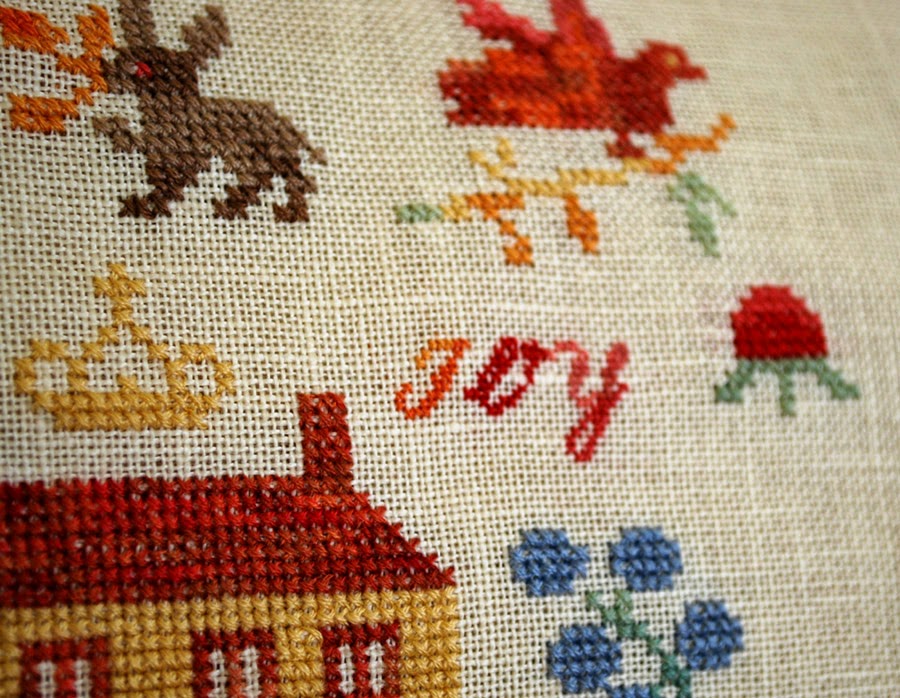
     Speaking of samplers, I finished the one I had designed for Sophia and presented it to her. Do you remember she requested a house sampler months back? To make the top half I followed a chart of a girlhood sampler of the 19th century. Then I fit together spots from several samplers for the bottom half. “E” is the family initial. The trees are the Christmas trees adjoining their property. The sprig of blueberries is reminiscent of Maine.

     The single strawberry is just-because she loves strawberries, which ripen during the month of her birthday.


    At last, I chose the word “Joy” in teeny tiny one-over-one stitches. It is such a little word but its deep gratitude makes a “cup runneth over.”

     Sophia is the only female in her household and I in mine, so we treated ourselves with girl-talk. Later, on the front porch, when the sun was lowering in the sky, the breeze blew through the silver wind chimes. I commented on how clear and pretty the chimes sounded. “That’s because this one,” she pointed out, “chimes the first notes of Amazing Grace.”
     “Really?” I said brightly then listened some more. The beautiful chimes created a lull in our conversation, which few things can do once girl-talk gets on a roll.


Thank you for your visit,
Karen Andreola


More News
     Here is a link for Sonja Schafer’s blog interview. At the end of the interview you will see that Simply Charlotte Mason decided to sell all my books. Neat. Perhaps there is a description of one that sounds like it would uplift your life. If so, I hope you will consider purchasing it on their website. If you like your visits here you will feel very at home on the pages of my books.

     During my week away I used my daughter’s computer to read my emails one evening. What a surprise. The mice at Linnie’s Butt’ry and Book’ry chose my name for the prize of a handsome gardening book. Fun.      

Monday, May 26, 2014

With Cauliflower and Kindness


With Cauliflower and Kindness

     I was young and impressionable. A wife at 19, I was collecting impressions. My eyes were wide open to new aspects of living and learning. Dean and I were newlyweds and attending college together in Massachusetts.

cauliflower soup

     The college was an easy walk to Dean’s sister, whose family, at that time, lived in a wing of the Josiah Quincy House (built in 1770).  Her husband was a photographer for the New England Historical Society. When he had gotten the inside scoop about a live-in curator’s position, he jumped on it. It enabled the family to take advantage of low rent with the condition that my sister-in-law would give tours of the Josiah Quincy House during the summer.


     One evening, in 1979, Dean’s sister invited us for supper. We walked through the old neighborhood over crooked sidewalks, past front porches, green grass and flowers in window boxes. The August sun was pink. It cast a rosy glow on the faces of the white clapboard houses. I thought, “I’d like to live in a neighborhood like this some day.”          

     When Dean and I arrived the little nieces were already tucked into bed. Standing in the narrow kitchen we joined in the chatter. Pots were simmering. The what-smells-so-good-odors filled our noses and set our stomachs growling. A minute later we were abruptly ushered out of the room. Puzzled, we followed our brother-in-law across the hall and through a private door. This door was the shortcut into the museum part of the house.

1770s dinning room


     With a wave of his arm, and the pull of a chair, he seated us at Josiah Quincy’s dinning room table. I blinked twice at the china, silver, cloth napkins and stemmed glasses. A snapshot shows the dinning room as tourist saw it then. (Dean’s father probably took this photograph along with the other Kodak pictures we scanned into the computer for this post. The back of the pictures is stamped 1986.)

Colonial Secretary


     In elegant cream soup bowls, on Josiah Quincy’s walnut table, cauliflower soup was served. I held my soupspoon gingerly, conscious to not sip or slurp. Such pampering made me feel a bit nervous. Intuition told me that this would be the pinnacle dinning experience of my life. Thirty-five years later, I am right so far. Eating in Josiah Quincy’s dinning room, by hush-hush special invitation of the curators, in an intimate atmosphere of American history, and surrounded by 200-year-old antiques, was an experience that has never been topped. 


red fireplace tiles


     I don’t recall anything else about the meal except that I esteemed my sister-in-law for her artistic homemaking skills. I thought, “I want to learn to cook like her one day – with fresh wholesome food.”


red wing chair - Colonial

     It was my first experience eating cream of cauliflower soup. Its garnish of herbs was pinched off the steams of plants growing out front, in a little ancient garden, primly bordered by boxwood. Although I cannot recall the other courses  – I was unquestionably enjoying the conversation  - everything was as delicious and as new to me as a Babette’s feast.

18th century tall case clock


     In the story, Babette’s Feast by Isak Dinesen, middle-aged Puritan sisters Martine and Philippa were used to plain food. They ate plain food all their lives. And they instructed their new cook, Babette, to keep meals properly bland. But after many years in their employ, and to celebrate a special occasion, Babette begged to make a French meal for them. The food brought to the table that evening was extravagantly French, cooked to perfection, delicious, and in every sense, foreign to the sisters’ palates - a pinnacle dinning experience. I finished reading the story recently. Did you ever see the film?

making cauliflower soup

     Dean’s sister is really a casual sort of person. She evidently dreamed up that supper in 1979 as a wedding gift for the newlyweds. It left a welcome impression on me. I’ve been making cauliflower soup ever since.

     While mincing shallots, sometimes the meal in the museum comes to mind. Then, I am encouraged with,

“as ye are pampered, go ye likewise and pamper one another – with cauliflower and kindness”

- a funny little motto I made up. After all, what are blogs for but for collecting impressions and giving them?

A sprinkle of thyme on cauliflower soup made with coconut milk

Thanks for stopping by my place – as well as Josiah Quincy’s,
Karen Andreola

kitchen fireplace
Our kitchen oven is behind these retractable wooden doors


Post Script

     Josiah Quincy was a colonel in the American revolutionary war. Click here to see his house - which looks like those that girls stitched into their linen samplers in the 18th century.   

Colonial green trim
I'm considering green trim like this Quincy bedroom for my parlor trim


Thursday, May 15, 2014

Little Hands, Little Books, But Not Just Little Words


Little Hands, Little Books, 
But Not Just Little Words

     We watched three wild rabbits grow up last summer. Mornings and evenings they fed and frolicked at the outskirts of the woods, not far from their mother. They skipped and tumbled off rocks and poked their stubby noses under things and into things – even nosing the sprinkler on the lawn when it wasn’t watering. For obvious reasons I called them the Flopsy Bunnies.


     Recently, I noticed the bunnies we have inside the house and that they would do nicely for decorating this post (where I quote from chapter 21 of A Charlotte Mason Companion.)


Pennsylvania wild rabbit


     I’ll let you in on a secret. In my efforts to be interesting, I will polish a post with a word outside of the course of everyday conversation. I'm finicky about words. But I do it also for your entertainment. And, it also helps me present an idea. Even a simple idea, to borrow a phrase of Mr. Darcy, is “brightened by the exercise” of a meaningful word. It goes by principle.
     Do we feel dull? Perhaps we are confining ourselves to the narrow playing field of commonplace vocabulary. Such dullness is what’s in store for children when twaddle is set before them.

     Twaddle, or over-simplified vocabulary, has a deadening effect on the curious minds of children. It seems to be the human tendency to find language exciting, but this tendency will become latent when schoolbooks stick to words with a quickly digested significance.


redware plate with Easter bunny

     Words are wonderful.  The Christian handles them with respect.

     The Maker of Heaven and Earth chose words to make Himself known to us. When a believer is “in the Word” we are closer to Him (1 John 1). We worship the Lord with our actions, our intentions, our hearts, and with words.

     Around the world, wherever Christians have lived in community, the caring work of education has been there, too  – first, to teach the Word, and secondly, to contemplate and consider the words and lives of others. “The mouth of the righteous is a fountain of life.” Proverbs 10:11

     We want to read children age-appropiate” books, yet let’s be careful not to stagnate their intelligence by talking down to them with the blandest vocabulary. Rather, we can awaken their intelligence with fitting words that are new and delicious.
     There exists no verbal poverty in the stories of Beatrix Potter, for example. Edward Blishen, English teacher and author of the article, “Very Remarkable Words” – in Parents’ Review Vol. 6, wrote:


“Anyone who was brought up on Beatrix Potter will remember how the uncommon words glow in the clear setting of her style. When I first read the speech in Jemima Puddle-duck that begins ‘Before you commence your tedious sitting, I intend to give you a treat,’ I had no firm idea of the meaning of the word, ‘tedious.’ Indeed, the joy of it was that is was not easily capable of firm meaning. It was a word with a tone, a style of its own, to be treasured and used exploratorily thereafter.”


     In the article Mr. Blishen goes on to make his case against the twaddle found in so many children’s books. Twaddly books would never dream of using the word “tedious.” Their authors – who probably spend very little time relating to children, confine themselves to grade level vocabulary.


     I selected phrases from our copy of The CompleteTales of Beatrix Potter. We’ve had it in the house for more than twenty years. Checking, I was happy to find that this edition is still in print and provided a link. In this large volume Miss Potter’s books appear in the order that they were first published. What I’ve appreciated about this edition is the paragraph of introduction – a sort of biographical peek or background - placed before each tale.

     Here are some examples of verbal richness. Apparently Miss Potter was ignorant of strict grade level stipulations. I’m glad, aren’t you?


“It is said that the effect of eating too much lettuce is soporific.” The Tale of The Flospy Bunnies

“And everything was ready to sew together in the morning, all measured and sufficient – except that there was wanting just one single skein of cherry-coloured twisted silk.” The Tailor of Gloucester (a Christmas favorite of mine)

“And while Mrs. Jeremy sat disconsolately on the edge of his boat – sucking his sore fingers and peering down into the water – a much worse thing happened; a really frightful thing it would have been, if Mr. Jeremy had not been wearing a macintosh!”
The Tale of Jeremy Fisher

“Somehow there were very extraordinary noises over-head, which disturbed the dignity and repose of the tea party.” The Tale of Tom Kitten

“Mr. Jackson rose ponderously from the table, and began to look into the cupboards.” The Tale of Mrs. Tittlemouse  (I really “get into” reading this tale aloud.)

“Pigling squealed; then ran back frantically, hoping to overtake Alexander and the policeman.” The Tale of Pigling Bland

back of cross stitch

Beatrix Potter's little books    
     Along side, The Complete Tales of Beatrix Potter, I have a small collection of the tales in individual books – the way that they were originally designed by Beatrix Potter herself - that is - to fit into the size of a child’s hand. Thus this post’s title: Little hands, little books, but not just little words. 

    After long months, I’m going to see my busy, boisterous grandsons this weekend. When the boys start to run low on steam (which takes quite some time), I will invite them to sit still with Mimi and pick out one of my little books for me to read aloud. If it’s bedtime I can guess they will be happy to stay up long enough for me to read them all.


cross stitch rabbit ornament

Further Reading

“The Art of Beatrix Potter” is an article I preserved in Parents’ Reivew -Volume 4. It is illustrated with line drawings by my daughters Sophia and Yolanda during days-gone-by.

“The Crime in Beatrix Potter’s Plots” is a curious feature of Parents’ Review - Volume 3.


Comments are Welcome,
Karen Andreola


A Special Note
We are in the process of linking to Amazon for financial affiliation. Dean is still looking for work.