Monday, March 12, 2012

Knitting Squares, Knitting Tales


Knitting Squares, Knitting Tales 

My mother is a stickler for matching everything in a room with choice colors. She sews her own curtains, cushions, pillows and keeps to the color scheme with her coverlets, too. Every bed, chair and sofa in her bungalow has its own knitted throw or coverlet. There is no point in allowing oneself to be chilly, she believes.  


If you’ve read last year’s post “Mommy’s Mittens” you know that I learned to knit from my mother. It is only recently that I thought to ask who taught her. “The Brownies,” she said. “ Working back and forth on our rows – we learned to knit and purl - to make squares for the war effort. The squares were sewn together to make blankets for the WW II soldiers.”


In my copy of For the Love of Knitting compiled by Kari Cornell, is an old photograph of some girls of Brownie age knitting on a front porch.

It helped me picture my mother doing the same during a similar time period.


The next knitting experience found my mother sitting on a New Jersey beach in the summer sunshine knitting argyle socks keeping the contrasting colors neatly on bobbins behind her work. 

“That’s a big step,” I noted. “How old were you then?”

“I was fourteen. My cousin brought her knitting on the beach and she showed me how. I made argyle socks for my father,” she remembered with clarity. 


“Some years later I made an argyle tie for my boyfriend. He was in his first year of college.” That boyfriend has been her husband for 56 years. Here is my father in 1953 wearing his knitted tie. Doesn’t he look smart?


One of my mother’s favorite coverlets is a sampler of individual squares in solid cream. “What made it so interesting, she said, “is that each square has a different design to it of hearts, flowers, a windmill, a quilter’s star, etc. and uses some different stitches.”


She has always liked the color yellow probably because she savors the sunshine of summer – a much sought-after season of the year for her. 


As a matter of fact, the first blanket she ever knit was yellow. It was crafted in ardent anticipation of her firstborn baby. 


Here is a faded photograph of my mother and that chubby baby, yours truly, born in 1959. I was doted upon with yarn and a mother’s love.


Repeated washing has made the blanket a bit fuzzy but it survives in my possession today.  


 A True Tale
When my mother was in the hospital with kidney stones (she is an avid English tea drinker) she lay in bed next to a weak and infirmed lady. Having a friendly nature she struck up a conversation. It was soon revealed that she and the lady had knitting in common. Although my mother was dealing with her own pain she managed to get out of bed to help her roommate who was having trouble eating. The lady was grateful and felt a kinship with my mother. She felt safe to share a secret. She told my mother what she had stored in the bottom drawers of her dresser. There she kept the knitted layette sets for the grandchildren that were sure to come one day. But all four of her children, in their 30s, were not keen on getting married and starting families. "I’m counting on them changing their minds,” the lady said with hopefulness.

This continued for a week. My mother fed, talked knitting and to distract them from their pain the ladies also shared secrets. 


Fully recovered and home from the hospital my mother received a telephone call. It was from the daughter of her hospital roommate. “My mother didn’t make it but before she died she told me how kind you were to her. We very much would like you to come to her service.”

Even though she hardly knew the lady she and my father attended the memorial service an hour away. Few persons were in attendance. How startling it was for my mother to hear herself being named in the daughter’s speech and referred to as “Joan . . . the best friend of . . .”

Afterward the daughter pulled her aside and confided in her, “Joan, do you know what we found when we were sorting through my mother’s things? We found a dresser full of knitted baby clothes and blankets all in coordinated colors? They’re beautiful.”

“I think that is the sweetest thing,” my mother said acting surprised.


As a great-grandmother my mother is not as mobile as she’d like to be but she still enjoys knitting for babies and people of all ages. Above is the pastel blanket she knit for Baby Joseph.
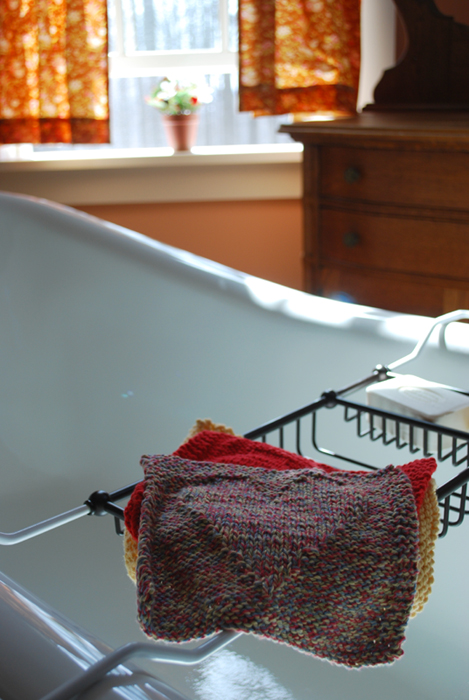


In the bath rests some knitted washcloths (cotton squares). Sophia (below) presented them to me at Christmastime confessing that it took two years to make the set. You can guess the connection I made. 


Post Script


My grandchildren will be here this coming weekend. I’ll get to see Baby crawl for the first time in person not just by email attachment.


Thank you for notifying me that the October 2010 post “Serendipity Decorating” has strangely disappeared. How odd. I will look into it. I’m always glad to hear from you by comment or email.


Until Next Time,
Karen Andreola

Thursday, March 1, 2012

A Kaleidoscope of Vegetables


A Kaleidoscope of Vegetables

Mr. Fortesque was once again the only guest at our supper table. “This is the most wholesome nourishment I’ve eaten all week. Such a kaleidoscope of vegetables in this soup,” Mr. Fortesque praised. Lessons at Blackberry Inn


The daughter of the Lady-of-the-House made a purple potato salad for her son’s birthday party. It is a reminder to us to eat our colors. Are you in need of a restorative? The Lady-of-the-House knows how admirably her readers love and serve, love and serve some more. Meanwhile her friends are recovering from surgery. Some are nursing a baby. Others are living with various ailments and chronic pain. The Lady-of-the-House can empathize and in this post takes on the role of big sister (naturally bossy) and mother hen (provokingly protective).

“The best doctors in the world are Doctor Diet, Doctor Quiet and Doctor Merryman.” Jonathan Swift (1667-1745) satirist, author of Gulliver’s Travels.


Lifting vegetables and fruit up to a higher status than it is given in the standard American diet is the urging of the Lady-of-the-House. The benefits of eating vegetables are numerous. The fact that they prevent cancer reveals their astonishing power to keep us well. 


When eaten in abundance – rather than being tacked on to a meal as an afterthought - they help lessen pain as they contain anti-inflammatory properties. They are a soothing aid to digestion. Eaten in place of processed carbohydrates they politely balance weight without the impertinence of calorie counting. The benefits of a palette of colors (eaten raw or lightly cooked when possible) are attracting the attention of more and more women who have decided to use their kitchens for supporting the health of those they love and serve. And themselves.


Because they seem to be the most tender, the Lady-of-the-House keeps an eye out for the smallest spaghetti squash. It is cut in half, seeded, baked skin-up at breakfast time. Most mornings you can find her doing some sort of vegetable preparation. Spaghetti squash can be fluffed with a fork, gently seasoned, and served at lunchtime in its own skin. 


While a pot of oatmeal is simmering the Lady-of-the-House may be simultaneously steaming broccoli. This super food takes five minutes to peel and cut (peeling the stalks makes them more edible) and five minutes to steam bright green. Cooled and set aside makes it handy for adding to a green salad, a pasta or rice dish or blending it into a creamy coconut milk soup. It is almost hidden to the eye when chopped (or minced) but will add one of the biggest boosts of vitamins on your table. 


Butternut squash baked at breakfast makes it ready for a lunchtime side dish or a light but nutritious dinner desert served individually with a few drops of honey and a pinch of pumpkin pie spice. 

Romaine lettuce cleaned, cut and spun at breakfast can be used in a green smoothie. The Man-of-the-House started this custom. His wife followed suit. They also place dandelion greens or beet greens and orange beets into a Vita Mix smoothie. Orange beets do not stain the hands during preparation but the Lady-of-the-House doesn’t mind red beets when a few frozen strawberries are tossed in the Mix. It makes a pretty pink smoothie. 


Red peppers are a super food. Peeling the skin makes them more digestible and only takes minutes.

Peppers can be diced and added to bean soup or a quick 30-minute simmering soup of red lentils near the end of cooking.


Petite-diced vegetables and grated carrot make a refreshing addition to a bowl of protein-rich quinoa sprouts.


Sprouting jars of quinoa, lentil and mung beans were taken out of the dark pantry and placed on the windowsill to be photographed. You can see how the Lady-of-the-House got carried away. She over filled her jars. This living food takes up more room than might be anticipated as spoonfuls quickly turn into cupfuls.


“There are ten minutes in the life of a pear when it is ripe to eat.” Ralph Waldo Emerson

Unlike the ever-ready apple a pear is stubbornly precise about when it can be eaten. The day the Lady-of-the-House came across the above quote she smiled and immediately related it to the avocado. Since that day she started keeping these two temperamental fruits in the same “waiting” bowl. The avocado is a super food that makes a wonderful baby food.


Brussels sprouts lightly coated with olive oil and a drizzle of Italian dressing can be roasted in the oven until fork tender. This is the preferred way the Lady-of-the-House cooks them. Still, the Man-of-the-House and his son will not be cajoled into eating cabbage no matter how she prepares it. “That’s okay, it just leaves more for me,” she tells them with her nose just a bit in the air. And the next day the leftover Brussels sprouts are mixed into pasta that is tossed with juicy roasted red pepper, Greek olives, grape tomatoes halved, with oregano and thyme (or pesto) – fabulous.


Is there any plant food you don’t like, you might ask the Lady-of-the-House? She admits to once repressing a gag over tofu. But when marinated and heated in the sweet and sour glaze out of Terry Walters’ Clean Start cookbook, she has even acquired a taste for it. This sauce flavors vegetables, too and is liked by her menfolk.

Bok choy cut into bite-sized pieces takes five minutes to steam. The Lady-of-the-House combines bok choy with green beans and broccoli. The sauce is pungent enough to turn a patter of vegetables into a flavorful dish for a family four to six. 

In a custard cup have ready:
2 Tbl olive oil
1 Tbl grated ginger root

Wisk together in a bowl:
2 Tbl tamari
2 Tbl real maple syrup
2 Tbl lime juice

Heat grated ginger in olive oil in a wide pan for 1 minute. Add steamed vegetables to the pan to heat and mix with ginger. Pour sauce over vegetables. Mix to coat. Serve on a platter.


There are many ways to serve vegetables, many ways to eat a kaleidoscope of colors – some simple - some fussy -with new sauces, salads and soups to try. 


This grace in First Prayers is reprinted from The New England Primer. It makes a fitting finish.

Bless me, O Lord,
And let my food strengthen me to serve Thee,
For Jesus Christ’s sake. Amen

Discussion is invited.

Post Script
Snowdrops along the shady wooded roadside were spied on a recent walk. Being one of the Lady-of-the-House’s most appreciated blooms the Man-of-the-House took a photograph for her when a sliver of late afternoon sun had shone through the trees. 


To Your Good Health,
Karen Andreola    

Saturday, February 18, 2012

The Well-Fed Mind


The Well-Fed Mind


There is never a time when I appreciate the sun through my windows more than in winter. Special notice is taken of where sunlight enters the house – at what window - at what hour.


Soft morning light enters the picture window over the kitchen sink while I make breakfast. By noon the sun shines directly through the little attic windows of my office/sewing room where I am writing to you now. It filters through the leafless trees and brightens the parlor in late afternoon. As it begins to set lazily, it lends its light to the blown glass at the front door.


Coming down the stairs this light always catches my notice with its strange distorted rays in the front hall. For one fleeting half-hour it illuminates the picture hanging there (which changes at a whim).


This month it is a print by Tasha Tudor. A mother is feeding her children. She wears a smile. We see the quiet joy she has in satisfying the appetites of those she loves. 


In chapter two of her Philosophy of Education Miss Charlotte Mason recognizes that mothers have an understanding of the baby.


“They know that his chief business is to grow and they feed him . . . They give free play to all the wrigglings and stretchings which give power to his feeble muscles. His parents know what he will come to, and feel that here is a new chance for the world. In the meantime, he needs food, sleep and shelter and a great deal of love.” 

Wholesome Nourishment
In her writings Charlotte Mason shows what parents and teachers owe to a child in his later years -  “those years in which he is engaged in self-education, taking his lessons from everything he sees and hears, and strengthening his powers by everything he does.” She repeats herself when she says that, “mind must come into contact with mind through the medium of ideas.”

“Education, like faith, is the evidence of things not seen,” is a curious saying of hers.

Education involves intangibles. Therefore Miss Mason offers an analogy. As the body is meant to grow upon food, which is composed of individual living cells - in like manner the only fit sustenance for the mind is ideas. Like the cells of the body an idea goes through stages of development. We receive an idea with an appetite and some stir of interest. Then, by association, another facet of an idea is added and like my grandson’s snowball, it grows and grows, layer by layer.* The more a child learns the more associations he automatically makes. Teachers who trust in the well-fed mind need not depend on elaborate lesson plans where all subjects are made to correlate in as many ways as possible.   


Mind Set in Motion
Ideas snowball in the mind of a child. They are not stationary, not stagnant. They come to children through various means; through observing nature, appreciating art, and melody; through the rhythmic movement of games, handicrafts, good conversation (not text-messaging), a Sunday sermon, etc. Most importantly they are found in living books. Through books of literary-quality a child gains knowledge mind-to-mind. Miss Mason recommends quality, variety and quantity.

A good remedy for boredom and inattention is a revitalizing presentation of ideas.
Intellectual vitality (something necessary for gaining knowledge “for keeps” – for making knowledge personal) is set in motion when ideas are present.

The Living Book Test
It is safe to say that a living book is authored by someone who takes an enthusiastic interest in his subject. If the book is for children the facts might be related in story form. But they are always clothed in literary language. The test of identifying a living book is like the test of good literature in general. It must be three things. It must bring truth, nobility, and beauty.

It is not dumbed-down but is somewhat intellectual and brings truth.
It is ethical so that we are well-nourished with noble ideas.
It is also artistic and makes its appeal through the emotions.

The Human Touch
Charlotte Mason reminds us that, “children are born persons.” As human beings the style of writing that appeals to them is that which includes the human touch. So we look for books with that touch of originality – books that warm up the imagination. This kind of writing will satisfy a child’s curiosity and foster a love of learning. For all its vivifying features a living book has the right to be called a schoolbook.


Lassie Come Home
One advantage of home teaching (and it is a big advantage) is that the parents are the ones who choose off the world’s menu of ideas. They pick the schoolbooks.            

Eric Knight’s, Lassie Come Home is one example of a book that passes the living book test. If you’d like your child to have an understanding of devotion, courage, hope, brotherly kindness and perseverance this story is a touching example of it. Published in 1940, this is the original story that made Lassie a legend. We made it a read-aloud in our family.

In a certain Yorkshire village there is no finer dog than Lassie. She is a well-trained, well-loved purebred collie – a dog admired by the whole village for her beauty and obedience. When a coalmine closes Joe’s father is out-of-work. Down cast he sells Lassie to put food on the table. Young Joe takes it hard. What makes it harder is that after she is sold to a wealthy duke, Lassie escapes from her kennel three times. Joe and his father must return her.

The duke has Lassie moved to his other estate way up in the north of Scotland so she will never escape again. But Lassie’s instinct is strong – especially her time-sense. It was her habit to meet Joe at exactly four o’clock at the schoolhouse every day. Therefore, near four o’clock when Lassie is restless, she slips through the gate and heads south to Yorkshire - to Joe and his family - with unwavering purpose.


It is a long, long way to Yorkshire. Lassie climbs hills and crosses streams. It is only when she collapses in utter exhaustion and is fed by gentle, caring persons that she stays awhile. With strength regained and a steady determination she sets off again. Parts of the story are somewhat grueling which might make it unsuitable at bedtime for your youngest listeners. It has a happy ending (even if imperfectly so.)


The classic 1943 MGM film starring young Elizabeth Taylor and Roddy McDowell closely follows the book and is the one I recommend. It will introduce you to the characters. This beautiful motion picture is one that brought a tear to my eye.  


*My son-in-law continued to push the snowball until it became enormous - to his son’s amazement. We were standing in the driveway when the clip-clop of a neighbor’s horse and buggy stole our attention. William was mesmerized. I snapped a photograph in the nick of time.


May you leave your visit here today with a little seed of an idea slipped into your pocket.
Karen Andreola